

CBSE Class 4 EVS – Looking around – Takshila-DPS Pune- Patna-Coimbatore

AUTHOR
MBBS, DNB (DVL)
Dermatologist, Cosmetologist and Laser Surgeon
Nuleaf Skin Clinic and Hair Transplant Center, Undri, Pune
The following notes are from the academic year 2022-23 of DPS Pune- Patna-Coimbatore, compiled by my twin daughters. These notes include all the important material of the chapter which can be asked in the exam, compiled from the EVS textbook, study course material books and the notes from class.
Readers, if you find these notes helpful please do write your views in the ‘comment section’ of this article and if you like me to upload any notes on any topic taught in class 4, please be free to post your replies. Subscribe to my blog for new updates, notes and posts. Have a great year and all the best.
CHAPTER 16: A BUSY MONTH
Important Points which can be asked as ‘Fill in the Blanks’ or ‘MCQs’:
- Like humans, animals also need shelters to protect themselves against heat, cold, rain and enemies. Animals need shelters to live safely. Many animals live in natural shelters. These are provided by trees caves and soil.
- The environment in which an animal lives in is referred to as its habitat
- During our lifetime, we get 20 number of milk teeth and 32 permanent teeth.
- The cuckoo does not build its own nest. It lays its eggs in the crow’s nest.
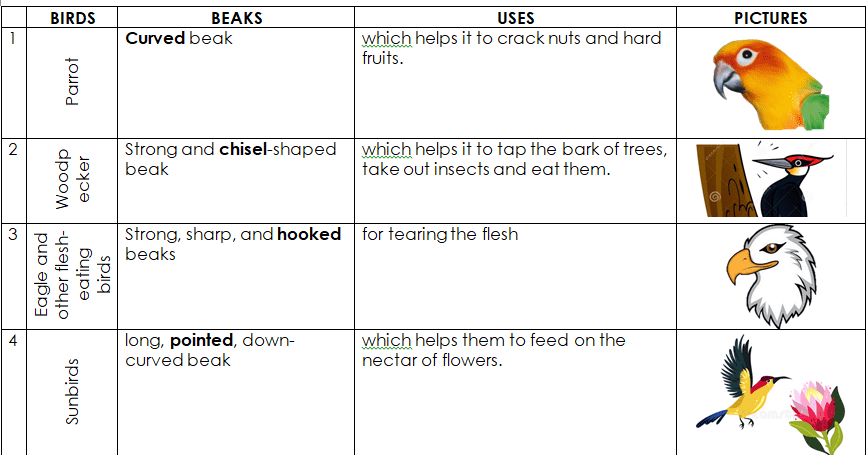
- Parrot has a curved beak which helps it to crack nuts and hard fruits.
- A tailor bird uses two or three big leaves to build its nest.
- Give one example of each kind of bird who has:
- Strong and chisel-shaped beak. Woodpecker
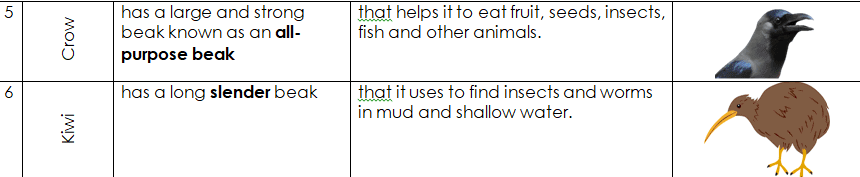
- Long slender beak. Kiwi
- Long pointed, down-curved beak. Sunbird
- Strong and sharp claws. Vultures, Eagles
- Long legs with spreading toes to wade through muddy water. Crane.
- Name the following: –
- A bird that does not make its nest and lays eggs in a crow’s nest. Koel (Cuckoo)
- A bird that makes its nest in the trunk of the tree. Woodpecker
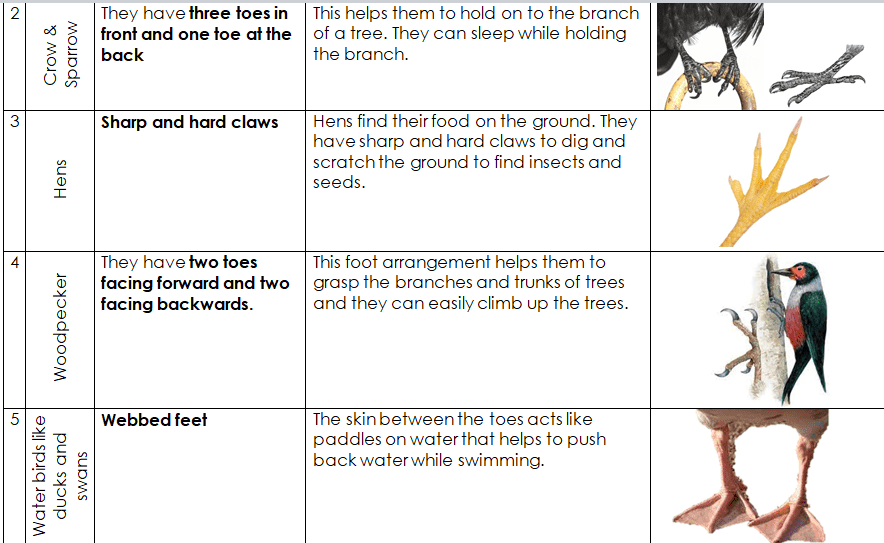
- A bird that has sharp and hard claws to dig and scratch the ground to find insects and seeds. Hen
- The long-curved nails on the toes of the birds. Claws
- The bird which lays its eggs in the nest of other birds. Koel (Cuckoo)
- Birds can use their beak and feet (claws) to carry materials and to build their nests.
- Eagle, Vulture and Kite are flesh eating bird.
- Animals that do not chew their food but swallow their food whole: house lizards, frogs, snakes.
- Peacock is the national bird of India
- Ostrich is the tallest and the heaviest bird
- A bird that can see in the dark (night-time) is Owl.
- It makes its nest between stones. Indian robin.
- Duck has webbed feet which help them to swim.
- Cows and buffaloes have large and flat teeth for chewing the grass.
- The crow has a large and strong beak known as an all-purpose beak that helps it to eat fruit, seeds, insects, fish and other animals.
- Ducks have three toes on each foot to walk on land.
- Squirrels keep gnawing on things to prevent their front teeth from becoming too long.
- Cows and buffaloes have large and flat teeth for chewing the grass.
- Animals that eat the flesh of other animals are called carnivores.
- Gijubhai Badheka lived in Gujarat. He wrote many stories for children.
- Letter was written on 13 April 1936 from Balmandir, Bavnagar, Gujarat.
- It is 3 o’clock in the afternoon. There are no clouds in the sky. The sun is burning hot.
- The sparrows, doves and sunbirds have started working in pairs as they prepare to make their nests.
- In Gijubhai’s courtyard also, there is a baby dove. There is another egg in the nest but it has not hatched yet.
INDIAN ROBIN:
- Where did he see the nest?
On the way to Gopalbhai’s house, there are many stones along the roadside. In the space between these stones, an Indian Robin has laid its eggs.
- Who showed him the nest?
Bachubhai showed it to me. I looked through the binoculars.
- What was the nest made of?
I saw that the nest was made of grass. On top there were soft twigs, roots, wool, hair and cottonwool. This is how the robin makes its nest. What a soft and cozy home for its chicks!
- What was there inside the nest?
I saw a baby bird in the robin’s nest. It was sitting with its beak wide open. The mouth was red from inside. In a little while the robin flew to the nest and put something in the chick’s open beak – may be a few small insects. By then it was evening. The robin settled down with its chick.
| Birds | Where do the birds make the nests? |
| Crow | high up on a tree. |
| Dove | among the thorns of a cactus plant or a mehendi hedge. |
| Sparrow | In and around our own house. It makes its nest anywhere – on top of a cupboard, behind a mirror, on a ledge. |
| Pigeons | old or deserted buildings. |
| Barbet or coppersmith | can be heard in the summer with its ‘tuk, tuk, tuk’ call. It makes its nest in a hole, in a tree trunk. |
| Sunbird | hangs from the branch of a small tree or a bush. |
- Inside the Sunbird’s nest Gijubhai could see a chick in the nest. It was sitting near the small opening in the nest. It was waiting for its mother to bring some food.
- All the birds are so busy these days. Making a nest and laying the eggs is only the first step. It is a difficult task to raise the young ones in the nest which had been made with so much effort.
- Birds have many enemies – humans and other animals too. Crows and squirrels, cats and rats – all of them wait for a chance to steal the eggs. Many times they even break the nest.
- To keep oneself safe from danger, to find food, make a nest, hatch the eggs and raise the chicks safely – all these are tests for every bird. And see – how the birds still sing with joy and spread their wings and fly freely.
NEST
Nest (Definition): A structure or place made or chosen by a bird for laying eggs and protecting its young ones.
Why do birds need nests? Why do birds build nests?
Ans) Birds need their nest to
- Lay eggs.
- To keep their young ones safe and warm in them.
- To keep themselves safe from danger.
Where do birds make their nests?
Ans)
- Different birds use different places to make nest.
- They choose their nesting place with great care, safe from enemies and bad weather.
- Some birds lay their eggs in a simple scrape on the ground. Others build their nests on the branches of trees, among the bushes, windowsills, holes, chimneys etc.
- Generally, females build nests but sometimes both parent birds and sometimes just the male may build them.
What materials do birds use to build nests?
Ans) Birds make their nests with many things available to them. They use different things like sticks, twigs, leaves, straws, feathers, hair, mud, grass, wool, cotton, thread, pieces of cloth and paper, wrappers or even wires to build the nest.
What helps birds to build their nests?
Ans) Birds can use their beaks and feet to carry materials and to build their nests.
DIFFERENT TYPES OF NESTS

Q) What happens once the nest is ready?
Ans)
- Once the nest is ready, the female bird lays eggs in it. The birds keep their eggs warm by sitting on them. After few days, the baby birds come out of the eggs. This is called hatching.
- The chicks that come out of the eggs are helpless. They do not have feathers and their eyes are closed. So, the parent birds feed and take care of them.
- Once their feathers grow and they learn to fly, then they leave their nests and start to live by themselves.
- After they leave their nest, different kinds of birds live at different places, some on trees, some near or on water, and some on land.
Q) Define Hatching:
- Once the nest is ready, the female bird lays eggs
- The birds keep their eggs warm by sitting on them.
- After few days, the baby birds come out of the eggs.
- This is called hatching.
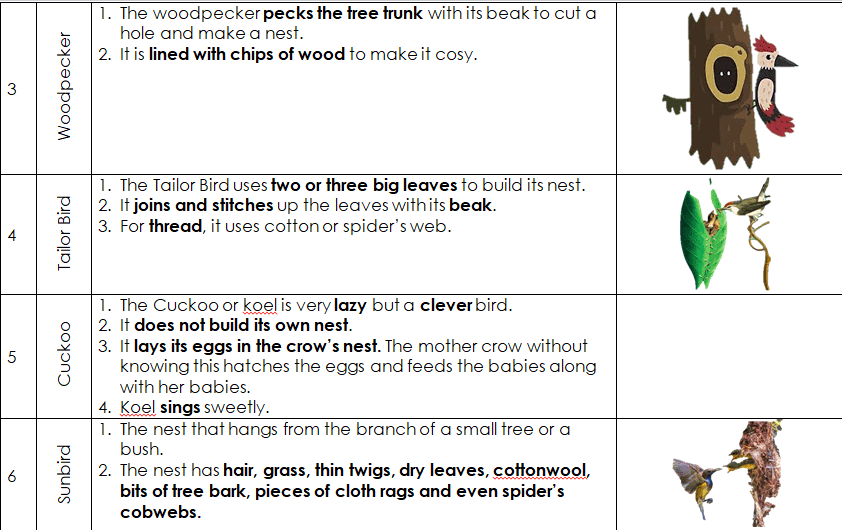
Q) How does the tailor bird make its nest?
Ans)
- The Tailor Bird uses two or three big leaves to build its nest.
- It joins and stitches up the leaves with its beak.
- For thread, it uses cotton or spider’s web.
GIVE REASONS:
A) The weaver bird’s nest is special. Why?
Ans)
- The weaver bird makes its nest by weaving grass.
- The nest is made cosy with cotton, wool, hair or small leaves.
- The male weaver bird makes beautiful woven nests.
- The female looks at all the nests and chooses the one that she likes the best and decides in which one to lay her eggs.
B) Robin’s nest is cozy as compared to crow’s nest. Why?
Ans) ) Robin’s nest is cozy as compared to crow’s nest because Robin’s makes its nest with grass, soft twigs, roots, wool, hair and cottonwool. Whereas crows make their nests with any kind of materials like wire, wood etc.
C) Cuckoo is a lazy bird. Why?
Ans)
- It does not build its own nest.
- It lays its eggs in the crow’s nest.
- The mother crow without knowing this,hatches the eggs and feeds the babies along with her babies.
Q) How does a woodpecker make its nest?
Ans)
- The woodpecker pecks the tree trunk with its beak to cut a hole and make a nest.
- It is lined with chips of wood to make it cosy.
FEET AND CLAWS OF BIRDS
Structure:
- A bird has two legs.
- Each leg has two to four toes.
- At the top of each toe, there is a claw.
- Claws are the long-curved nails on the toes.
- Birds use their claws for:
- grasping or catching their prey,
- for perching,
- for scratching the ground,
- climbing,
- protecting themselves,
- holding food etc.
DIFFERENT TYPES OF CLAWS AND FEET:


BEAKS
- Birds have beaks instead of teeth.
- The beaks are also called bills.
- Different types of birds have different types of beaks.
- Birds use their beaks to
- get food,
- drink water,
- tear or break food into pieces,
- gather nesting material,
- feed babies,
- and protect them from enemies.
DIFFERENT TYPES OF BEAKS
Birds have different types of beaks as per their eating habit
Q) How does the broad beak and short beak of swallow help it to catch insects?
Ans)
- The broad, short beak is sticky inside.
- While moving in air, insects get stuck in its mouth.
Q) Why does a duck have tiny holes at the sides of its broad and flat beak?
Ans)
- The beaks of ducks and swans are broad and flat like a spoon.
- There are tiny holes on either side of the beak.
- Ducks and swans find their food in the water. When they spoon up the muddy water, the water flows out leaving the insects, worms and water plants behind.
FOOD HABITS OF ANIMALS
Animals need food to grow and to live. Food gives energy to animals.
Animals have different food habits. The food which the animals eat depends on the shape of their teeth and mouth. The shape of an animal’s teeth tells us what kind of food they eat.
| PLANT EATING ANIMALS (HERBIVORES) | Animals that eat plants are called herbivores. | Horses, camels, cows, sheep and goats. | They have rows of wide, flat teeth for chewing grass, leaves and other tough plant matter. |
| Cows | Cows have short front teeth for snipping the grass. The teeth on the sides are large and flat for chewing the grass. | ||
| FLESH EATING ANIMALS (CARNIVORES) | Animals that eat the flesh of other animals are called carnivores. | Lions, tigers, cats, etc. | They have long pointed teeth to grip their prey and sharp teeth for cutting up meat. |
| OMNIVORES | Animals that eat both plants and animals are called omnivores. | Bear and human beings | They have a mixture of sharp teeth for eating meat and flat teeth for chewing. |
| OTHER ANIMALS | Snakes | They have curved sharp teeth (for venom gland) but they do not chew their food. They swallow their food. | |
| House lizards and frogs | They swallow their food whole. They have a wide mouth and a sticky tongue to swallow their prey. |
Q) GIVE REASONS
A) Squirrels keep gnawing on things. Why?
Ans) Squirrels keep gnawing on things because:-
- Squirrel’s front teeth keep growing throughout their life.
- They need to reduce its size, to keep them from becoming too long.
TEETH IN HUMAN BEINGS:
All human beings who take care of their teeth have thirty-two teeth. Our teeth chew and bite food into smaller bits so that it may be digested easily. During our lifetime we get two sets of teeth.
a) 20 milk teeth
b) 32 permanent teeth
Thanks a lot for visiting my blog. Please do ‘★ LIKE’ the post if you found it to be useful. Your comments, suggestions, criticism and all opinions are very much appreciated. Please do write your queries in the Reply/comments section and I will try to get back to you asap.

All the content on this blog is copyrighted. It takes immense research, hard work, patience and time to come up with a comprehensive article/post. If you like and need to use any of my article(s) or any part of it, please do give the requisite reference, link or credit to my website/blog . DO NOT COPY WITHOUT PERMISSION.
 Raising Twins™