
CBSE Class 4 EVS – Looking around – Takshila-DPS Pune- Patna-Coimbatore
The following notes are from the academic year 2022-23 of DPS Pune- Patna-Coimbatore, compiled by my twin daughters. These notes include all the important material of the chapter which can be asked in the exam, compiled from the EVS textbook, study course material books and the notes from class.
Readers, if you find these notes helpful please do write your views in the ‘comment section’ of this article and if you like me to upload any notes on any topic taught in class 4, please be free to post your replies. Subscribe to my blog for new updates, notes and posts. Have a great year and all the best.
Important Points which can be asked as ‘Fill in the Blanks’ or ‘MCQs’:
- Animals and plants need water to live.
- We can survive without food for a month but not more than a week without water.
- There is plenty of water in nature.
- Sea water is salty because it contains a large amount of sodium chloride.
- The path that a river takes is called a course.
- Water is found in oceans, seas, lakes, rivers, ponds and streams. It is also found under the ground, in the glaciers and in the air. But out of all the water in nature, very little is really usable.
- Water is the basic unit of life.
- The water we drink from rivers and tanks is not pure or clean.
- In the olden days, villagers usually used Alum when they brought water from rivers and ponds.
- Oil forms a layer on water because it is lighter than water.
- Water is known as universal solvent.
- Filtration is a method that removes only solid impurities.
- Water fit for drinking is called potable. (Portable- movable)
- Rainwater that seeps into the soil and gets collected is known as ground water.
- The state of water will change when it is heated or cooled.
- Boiling of water kills the harmful germs present in water.
- Chlorine kills bacteria in water.
- Alum helps in increasing the rate of sedimentation.
- Oil does not mix with water.
- Puddles around your house or school dry naturally due to evaporation.
- Water from decantation or filtration is still not fit for drinking as soluble impurities (germs) are there.
- Seawater is not fit for drinking as seawater is salty.
- A chemical used to clean water is Chlorine.
- The primary source of water – rain
- Most common reason of water pollution affecting marine life is oil spills.
- Most common method of killing soluble impurities in water is boiling.
- Methods that can be used to kill the germs in water: Boiling, Chlorine tablets, electric water filter.
- Filtration removes only insoluble impurities.
- Solids have fixed shape and volume.
- Water can also be purified using ultraviolet rays.
- Vinegar and water are miscible liquids.
- Chlorine is added to water to kill germs.
- Water is known as basic unit of life.
Questions and Answers
Q.1) Can human beings drink water from the seas and oceans?
Ans) Sea and Ocean water has lots of salts and other minerals. While humans can safely ingest small amounts of salt, the salt content in seawater is much higher than what can be processed by the human body. Hence, humans cannot drink water from the seas and oceans.
Q.2) What are the sources of potable and non-potable water?
Ans)
- Non-potable: Sea water is salty- so it is unfit for drinking. Glaciers and polar ice caps have frozen water which cannot be used.
- Potable: The main sources of drinking water are rivers, lakes, ponds, streams and ground water which we draw out through wells, taps and tube wells.
* Difference between Potable and Non-potable water.
Q.3) What are the states of water?
Ans) Water exists in three different forms: solid, liquid and gas. The state of water will change when it is heated or cooled.

Q.4) What are the Properties of water?
Ans) Properties of water are:
- Water is colourless and tasteless.
- Water has no smell or it is odourless.
- Water has weight and takes up space.
- It has a definite volume but no definite shape.
- Water is a universal solvent. It can dissolve a wide variety of substances.
Q. 5) What is the source of all rivers?
Ans) Melting of glaciers high up in the mountains and rain are the sources of water in all rivers.
Q.6) Briefly explain the journey of a river.
Ans)
- Rivers are natural flowing water bodies, generally of fresh water, that flow towards an ocean, a lake, a sea, or another river.
- They carry rain, melted ice, and snow as they flow downhill from mountains to plains.
- When a river begins its journey, its water is clean and fresh but as it enters the villages and cities it becomes contaminated (not clean).
Q.7) Why are rivers important for living beings?
Ans) Rivers are important for living beings because they are used:
1. as a source of fresh water and food e.g., fish.
2. for irrigation.
3. as a mode of transport.
4. to generate electricity.
Q.8) What is water pollution?
Ans) Water pollution is the contamination of water bodies (dirt, sewage, and household and industrial wastes), usually as a result of human activities. It is major concern.
Q.9) What are the causes of water pollution?
Ans) The causes of water pollution are:
- Industrial waste: Different kinds of industries are situated on the banks of the rivers; these industries discharge their wastes in the water making it extremely poisonous.
- Pollution of rivers by other sources: Rivers also get polluted by washing dirty clothes, utensils, bathing animals etc.
- Disposal of sewage: In most of the cities, sewage and household waste is disposed into water bodies which pollute them.
- Agricultural wastes: Agricultural wastes like fertilisers, pesticides etc. reach the underground water via soil and cause water pollution.
- Dumping: Dumping of solid wastes and litter like glass, plastic, aluminium, thermocol etc. in water bodies causes huge problems.
- Oil spills: – Big tankers and ships loaded with oil sometimes discharge their oil accidentally in sea water causing threat to marine life.
Q10.) What are the harmful effects of water pollution?
Ans) Harmful effects of water pollution are as follows: –
- It causes many allergies and water borne diseases such as diarrhoea, hepatitis (jaundice), cholera and typhoid.
- Plants and animals that drink or live in or around that water become infected and unhealthy.
- Fish and other marine animals may die and the balance of nature may get destroyed.
- Due to oil spills, fishes and other animals die in millions as their respiratory organs get clogged by the oil.
Q.11) List some ways to control water pollution.
Ans) We can control water pollution by:
- All domestic and industrial sewage should be treated before being discharged into a water body.
- We should not throw any kind of waste including polythene bags in the water bodies like ponds, lakes and rivers.
- Activities like bathing, washing clothes, defecating and urinating near the water bodies should be discouraged.
WATER – THE BASIC UNIT OF LIFE.
- SOLUBLE SUBSTANCES:
- The substances that dissolve/disappear completely in certain fluids are called soluble substances.
- Example: The substances like salt, sugar, etc. completely disappear in water and are soluble substances.
- Solution: When two substances are mixed and if one dissolves the other, a solution is formed.
- A solution has two parts: a solute and a solvent.
- Solvent: The substance that dissolves another substance is called solvent. E.g. water is the solvent in salt solution.
- Solute: The Substance that gets dissolved is called the solute. E.g. Salt in salt solution.
- Example: Solute (sugar) + Solvent (water)= Sugar solution.
- INSOLUBLE SUBSTANCES:
The substances that do not dissolve /disappear in water even if we stir for long time are called insoluble substances. E.g. sand, mud, sawdust, flour etc.
- MISCIBLE LIQUIDS: The liquids that dissolve/mix completely with water are known as miscible liquids. E.g. lemon juice, vinegar etc.
- IMMISCIBLE LIQUIDS: The liquids that do not dissolve/mix with water and form a separate layer when kept aside for some time are known as immiscible liquids. E.g. kerosene, mustard oil, coconut oil etc.
| Soluble substances | Insoluble substances | ||
| 1 | The substances that dissolve/ disappear completely in certain fluids are called soluble substances. | 1 | The substances that do not disappear in water even if we stir for long time are called insoluble substances |
| 2 | E.g. salt or sugar in water | 2 | E.g. sand or mud in water |

Q6.) How are insoluble impurities removed from water? (OR) Separation of substances (impurities) from water (OR) How is Purification of water done?
Ans) Insoluble impurities like sand and mud can be removed by two simple methods:
- Sedimentation and decantation
- Filtration
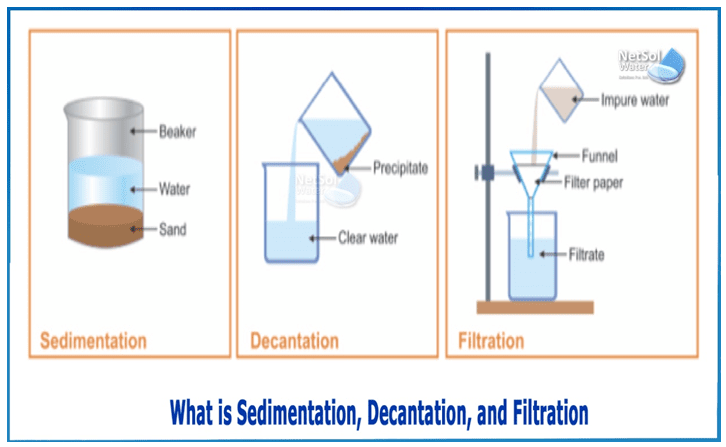
- Sedimentation is a process in which the heavier solid particles present in a liquid, settle down at the bottom of the container.
- Decantation is a process of separating the lighter liquid by tilting and pouring it into another vessel.
- Filtration is a method for separating an insoluble solid from a liquid using filter paper.
*Q) Difference between Decantation and Filtration.
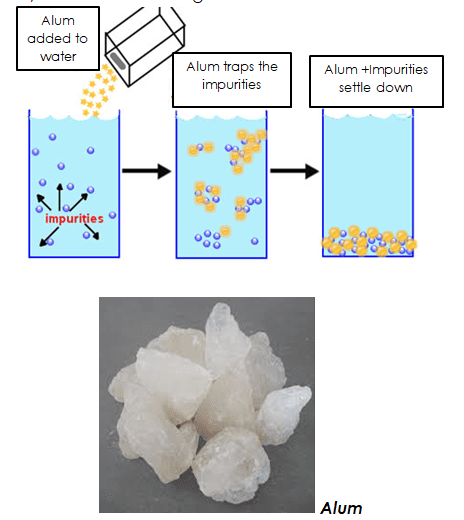
How does Alum work? (OR) Alum is added to increase the rate of sedimentation. Why?
Ans)
- Alum helps in increasing the rate of sedimentation.
- When alum (external agent) is added to water all the insoluble solid particles of the mixture get collected on alum and form heavier particles.
- As heavier particles sink in water, these dirt particles settle down, therefore increasing the rate of sedimentation.
How do Chlorine tablets work?
Ans)
- Chlorine tablets act as disinfectants by killing the microorganisms during the treatment of water and hence maintaining its quality for drinking.
- Chlorine is effective against a large variety of microorganisms that cause waterborne diseases like typhoid, diarrhoea, cholera, hepatitis (jaundice), and many more.

Two common methods used for making water absolutely fit for drinking are:
- Boiling as high temperature kills the germs.
- Electric water filters– There are many types of water filters that are used to purify water and make it fit for drinking.
*Q.)Draw two methods of separating insoluble impurities from water and one method of cleaning water for drinking
GIVE REASONS:
- Water from decantation or filtration is still not fit for drinking. Why? (OR) It is a common mistake that filtered water (using filter paper/cotton/gravel) is clean and safe for drinking.
Ans) Water from decantation or filtration is still not fit for drinkingbecause water contains germs (soluble impurities) which are not visible to our eyes. Filtration (using filter paper/ cotton/ gravel)only removes insoluble impurities. Soluble impurities present in water should be removed by boiling as high temperature kills the germs present.
- The major cause of marine (sea life) pollution is leakage of oil in the sea.
Ans) The major cause of marine (sea life) pollution is leakage of oil in the sea because –
- Big tankers and ships loaded with oil sometimes discharge their oil accidentally in sea water. A thick oil film spreads over the surface of water. This stops the supply of oxygen.
- Fishes and other marine animals die in million as their respiratory organs get clogged (become blocked) by the oil.
| WATER FILTER (*NOT TO BE ASSESSED)These electrical water filter systems are also integrated with Ultra-Filtration (UF), Reverse Osmosis (RO), and even Ultraviolet (UV) technologies that keep the microorganisms away from the drinking water. |
DEFINE:
- POTABLE WATER: Water that is fit for drinking is called potable water.
- WATER POLLUTION: Water pollution is the contamination of water bodies (dirt, sewage, and household and industrial wastes), usually as a result of human activities. It is major concern.
- COURSE OF A RIVER: The path a river takes to the sea is called its course.
- SOURCE OF A RIVER: The source of a river is the original point from which the river flows.
- SEWAGE: The waste water and waste from drains is called sewage.
- VOLUME: Space occupied by a substance is called volume.
Diagrams:

Thanks a lot for visiting my blog. Please do ‘★ LIKE’ the post if you found it to be useful. Your comments, suggestions, criticism and all opinions are very much appreciated. Please do write your queries in the Reply/comments section and I will try to get back to you asap.

All the content on this blog is copyrighted. It takes immense research, hard work, patience and time to come up with a comprehensive article/post. If you like and need to use any of my article(s) or any part of it, please do give the requisite reference, link or credit to my website/blog . DO NOT COPY WITHOUT PERMISSION.
 Raising Twins™