
CBSE Class 4 EVS – Looking around – Takshila-DPS Pune- Patna-Coimbatore
The following notes are from the academic year 2022-23 of DPS Pune- Patna-Coimbatore, compiled by my twin daughters. These notes include all the important material of the chapter which can be asked in the exam, compiled from the EVS textbook, study course material books and the notes from class.
Readers, if you find these notes helpful please do write your views in the ‘comment section’ of this article and if you like me to upload any notes on any topic taught in class 4, please be free to post your replies. Subscribe to my blog for new updates, notes and posts. Have a great year and all the best.
Important Points which can be asked as ‘Fill in the Blanks’ or ‘MCQs’:
- Sprinkler or drip irrigation should be used in agriculture.
- Get leaking taps repaired.
- In modern houses, electric pumps are used to lift groundwater.
- The water cycle is a continuous movement of water on and below the surface of the earth.
- Dehydration means excess loss of water from the body.
- The process of converting water vapour into water on cooling is known as condensation.
- Plants should be given water early in the morning or in the evening.
- Plants should not be given water in the afternoon/ middle of a sunny day.
- Dirty water harms our body.
- Electricity generated from water is called hydroelectricity/ hydroelectric power.
- Water is getting wasted due to water parks, water tap leakage and shower bath.
- We can obtain salt from seawater.
- Oil forms a layer on water because it is lighter than water.
- Water in hand pump comes from underground water.
- Practice of saving rain iscalled rain water harvesting.
- Water borne disease– Cholera, Typhoid, Hepatitis A, Dysentery
- Excess loss of water from body- Dehydation
- Home remedy for treatment of dehydration– Oral Rehydration Solution (ORS)
- Our Earth is called the blue planet as 70% of it is covered with water.
- We should drink lot of water when we have diarrhoea.
- Diseases spread by mosquitoes: Malaria, Dengue,Chikungunya.
- Gaseous form of water that is present in air: water vapour
- Amethod used in agriculture to conserve water. Drip Irrigation.
- Process by which plants lose water through leaves: Transpiration
- Purest form of water: Rainwater
- Mosquitoes breed in dirty and polluted water.
- On a sunny day, plants lose lot of water due to Transpiration.
- Water vapours are lighter than air and hence they rise up.
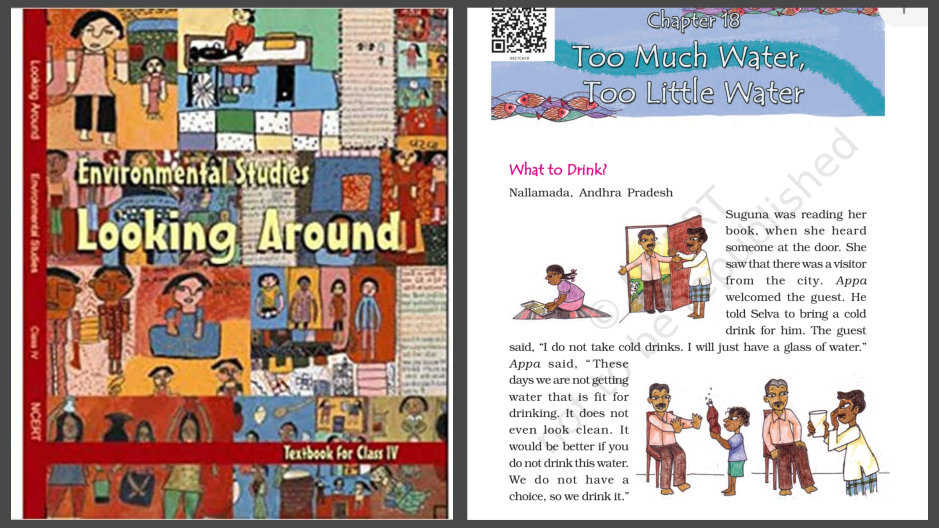
What to Drink?
- Saguna, Selva and Appa live in Nallamada, Andhra Pradesh.
- Suguna was reading her book, when she heard someone at the door.
- He told Selva to bring a cold drink for him.
Water Games
- There was a big water park near Bazaar Gaon, Maharashtra.
- Rohan and Reena went with their parents to the water park.
- In the park there were – water fountains, rides, big ponds, long thick water hose going zoom, zoom, zoom, big tall slide and swings.
- There was a crowd of people, outside the main gate of the water park carrying empty buckets and pots.
- A small child carrying an empty bottle was clinging to his mother.
Can We Drink This?
- Deepak had gone with his mother Pushpa to Raziya Madam’s house because he had a holiday.
- The lift stopped at the 26th floor.
- Deepak’s mother worked at Raziya Madam’s house at Cuffe Parade, Mumbai.
- The house was quiet and cool, and shining clean
- Raziya was reading a newspaper.
- Raziya switched on the TV and Deepak was soon lost in the world of cartoons.
- When we have diarrhoea and vomiting, we lose a lot of water from our body.
- Many people in Raziya’s locality were suffering from Diarrhoea and vomiting after drinking polluted water.
- Raziya asked Pushpa to boil the water and take it home as the gutter water had got mixed with the water in the drinking water pipe, boiling kills germs and gutter water was polluted.
Children show the Way
- Too little water, or no water, this was nothing new for the people in the Holgundi area of Karnataka.
- The children’s panchayat in Holgundi was called Bhima Sangh.
- Problem that was sorted out in Holgundi by the effort of the chidren’s panchayat – Drought
WATER CYCLE:
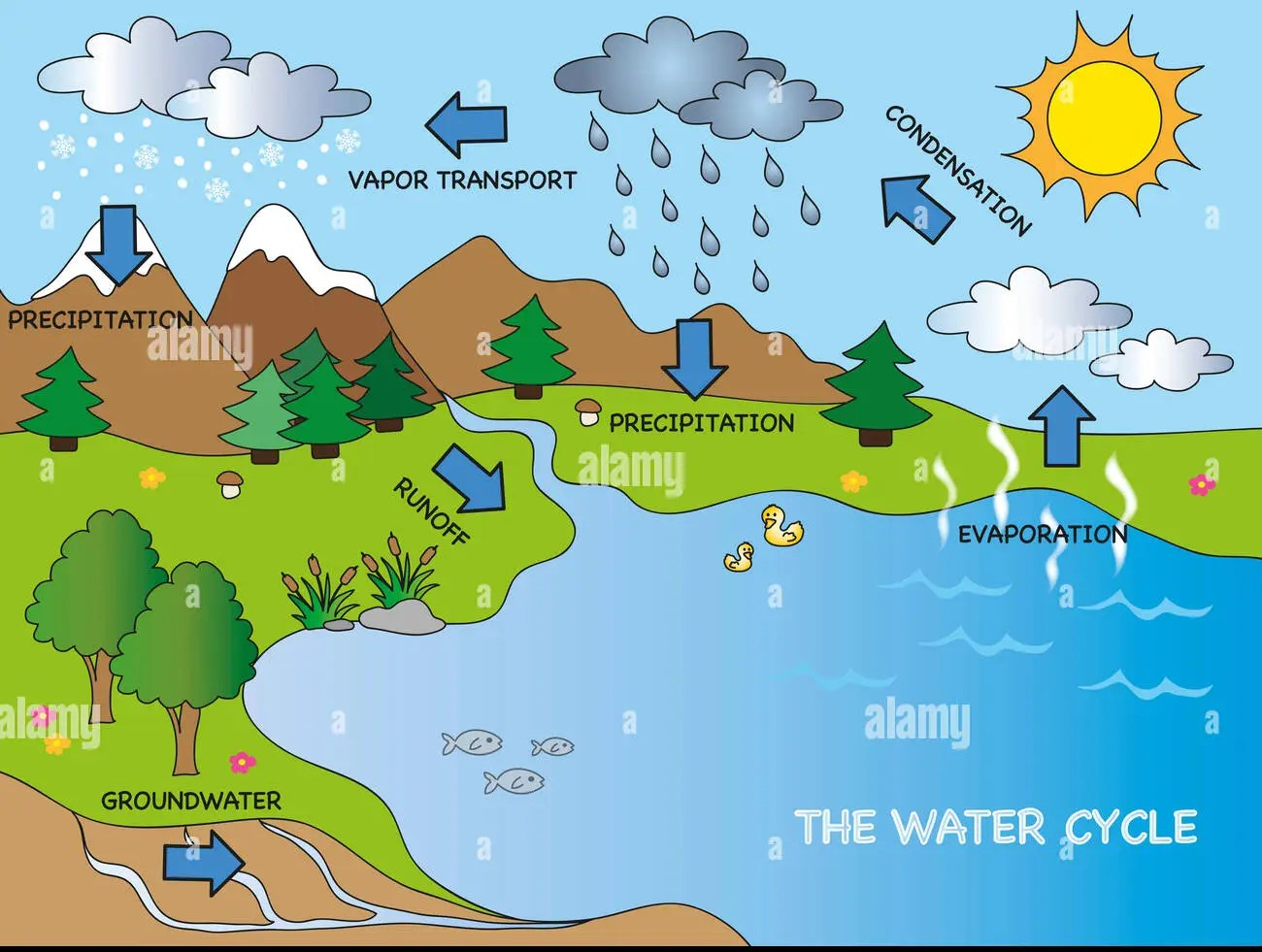
Definition: The process of continuous circulation of water from the earth’s surface to the atmosphere and from the atmosphere back to the earth is called the water cycle.
The various processes involved in the water cycle are:
- Evaporation:
- Definition: The process of conversion of water into water vapour on heating is called evaporation.
- In nature, the sun helps to convert the water in oceans, seas, rivers, lakes and other water bodies into water vapour.
- Condensation:
- Definition: The process of conversion of water vapour into water on cooling is called condensation.
- In nature, when the water vapour rises in the atmosphere it converts back into water droplets when it meets cold air.
- Precipitation:
- Definition: The condensed water droplets join to form clouds. When clouds become heavy, the air cannot hold them any longer. This water then falls on the ground as rain. This is known as precipitation.
- In nature in very cold regions, the water droplets in the sky freeze (ice) and falls to earth as snow or hail.
- Rain fills surface water bodies and seeps into the soil to increase the groundwater. Hence the water cycle is a continuous movement of water on and below the surface of the earth.
*Q) Difference between Evaporation and condensation
Uses of water:
- Water is essential to plants and animals for survival.
- Water is needed for all domestic work like cleaning, washing, bathing, cooking etc.
- It is needed for irrigation.
- All industries need water as a medium for manufacturing goods.
- Water is used to generate electricity called hydroelectricity.
- Water helps transportation and recreation.
Conservation of water
‘To conserve water’ means ‘to save water’ by using it carefully, wisely and by preventing its wastage. It is essential to conserve water as the amount of usable water on the earth is limited.
How can we conserve water in nature?
We can do the following things to conserve water:
- Close the tap when not in use.
- Get the leaking taps repaired.
- Take bath by filling water in a bucket instead of a shower.
- Use water carefully and avoid spillage.
- Water used in the kitchen and for mopping the floor can be reused to water plants.
- Sprinkler or drip irrigation method should be used in agriculture.
- Plant more trees as trees help to bring rain.
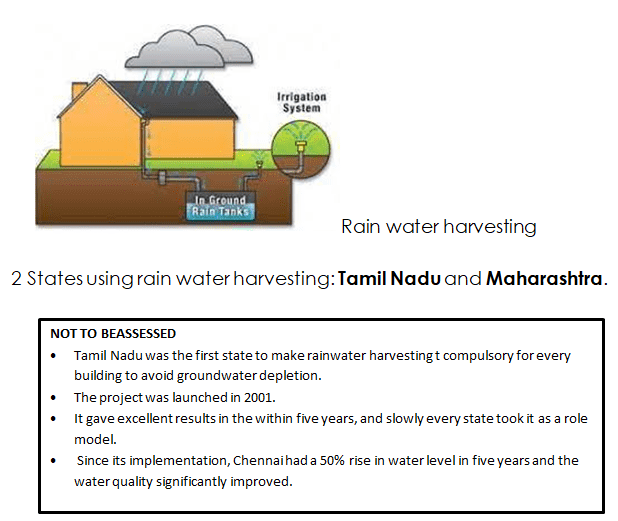
- Rain water harvesting.
RAIN WATER HARVESTING
*Harvest the rain, reap the gains…
Definition: Rain water harvesting is the process of storing any run-off water.
Why should we harvest rain water?
- We can store rainwater while it is raining and can use it later during the dry season.
- Large amount of collected water can be stored under the ground as groundwater.
- Rainwater is mostly free from harmful chemicals.
- It is cheaper.
- In modern houses, electric pumps are used to lift groundwater.
Question and answers:
Q1.) Name some water games played for recreation.
Ans) Swimming, surfing, water skiing, fishing, boating, etc. are some of the games played for recreation in water.
Q2.) What are the causes of the shortage of water?
Ans) Some of the causes of water shortage are:
- increasing population.
- growing requirements of agriculture.
- growth of industries.
- mismanagement of water like wasting water – in water parks in the name of recreation.
Q3.) Why is it essential to save water?
Ans) All of us need water every day for drinking, cooking, bathing, etc. The water considered fit for use by human beings is called potable Water. With the rise in water pollution it is essential to conserve water as the amount of usable water on the earth is limited.
Q4.) State any two slogans on ‘Importance of water’.
Ans)
- Save water, and it will save you.
- Water –The basic unit of life
- Water is life, treat it right!
Q.5) Name two Man-made and two natural sources of water.
Ans)
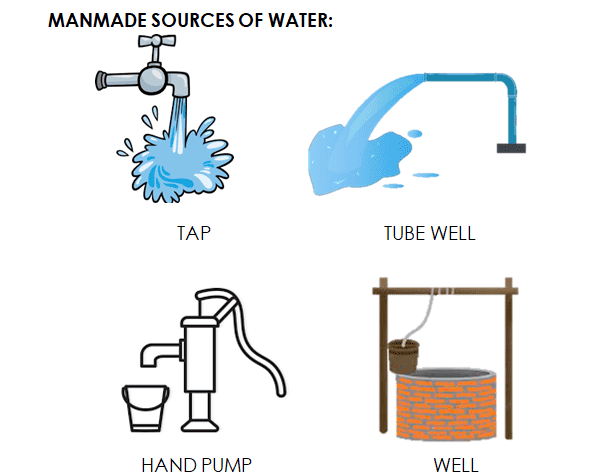
- Man-made sources of water: dams, wells, irrigation canals, pipes, water towers, tubewells, hand pumps, taps.
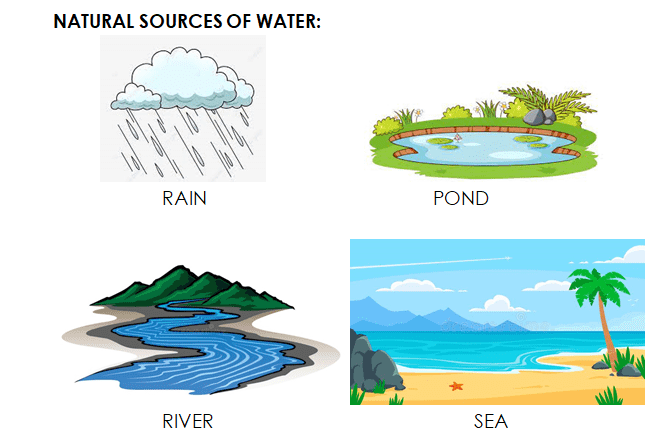
- Natural sources of water: rivers, lakes, ponds, ground water.
Q6.) GIVE REASONS
A) Dirty water harms our bodies.
Ans) Intake of dirty water causes several diseases in our bodies like diarrhoea and dysentery. This leads to loss of water from the body and causes dehydration.
B) Plants should be given water early in the morning or in the evening and not in the afternoon.
Ans. Plants should be given water early in the morning or in the evening and not in the afternoon because evaporation increases due to the high temperature of the sun during the afternoon. So, a lot of water gets wasted.
C) The occurrence of the water cycle in nature is a continuous process.
Ans. The earth’s water moves between water bodies, the atmosphere, and the land in a continuous cycle called the water cycle. The water in the water cycle moves in the form of liquid (water), gas (vapour), or solid (ice) through evaporation, condensation and precipitation.
D) Places around the drinking water taps or matkas must be cleaned regularly. Why?
Ans) Places around the drinking water taps or matkas must be cleaned regularly because stagnant water becomes a breeding ground for mosquitoes which spread diseases like malaria, dengue and chikungunya.
Q.10) How is water made safe for drinking at home?
Ans) Water can be made safe for drinking at home by:
- Always drink boiled water
- Always keep drinking water container covered.
- Clean water containers regularly
- Use a long-handled ladle to take water from the matka or container.
- Place around the drinking water taps or matkas should be cleaned regularly
Q.11) Why do the drinking water places get dirty? What can we do to keep these places clean?
Ans) Drinking water places get dirty if there is no proper drainage for the spilled water. Water collection due to leaking taps also can make the surroundings dirty. Fixing taps and building the area around drinking places with concrete with proper drains will keep the place clean.
Q.11) Why is underground water considered to be clean?
Ans. As water passes through various layers of sand and soil of the ground, to reach deep under the ground, it gets clean and filtered.
DEHYDRATION AND ORS
Q.1) What do you mean by Dehydration?
Ans: Dehydration means excess loss of water from the body due to diarrhoea or vomiting.
Q8.) Name some diseases caused by drinking dirty water.
Ans) Cholera, Typhoid, Hepatitis A (Jaundice), Dysentery, Diarrhoea, fluorosis, etc.
Q.9) What home remedy will you suggest for a person suffering from dehydration/ diarrhoea?
Ans.
- Drink a lot of water.
- Oral Rehydration Solution (ORS) to be given to a person suffering from dehydration. It can be made at home -Take a glass of boiled water (and cooled), add a pinch of salt and a teaspoon of sugar and stir it.
- You may add lemon for taste.
- Taste it to make sure that there is not too much salt.
- The water should not taste more salty than our tears.
- When a person has diarrhoea and vomiting, the water must be sipped slowly by them.
- Light food must be taken.
- Babies should continue to take their mother’s milk as this is good for them.
- It is also necessary to take some medicines – they can also be home-made remedies.
- If the diarrhoea does not stop, it is important to get the advice of a doctor.
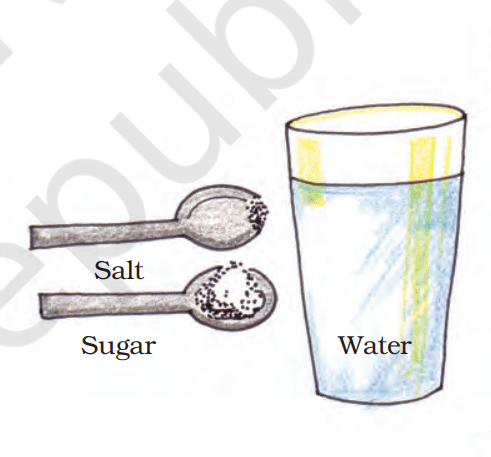
Q.10) Sonu gave ORS to her friend who was suffering from dehydration. Why? (2 points)
Ans) Sonu gave ORS to her friend who was suffering from dehydration, because –
- When we have diarrhoea and vomiting, we lose a lot of water from our body. This can be dangerous, if we do not make up for the water that we loose from our body.
- ORS contains water, salt and sugar in proper ratio which matches with the amount of electrolyte and water lost by body.
TEXTBOOK QUESTIONS
Q.1) Why did Appa offer a cold drink instead of water to the visitor?
Ans) Appa offered a cold drink instead of water to the visitor because for past few days they were not getting water that was fit for drinking. It did not even look clean. Appa’s family did not have a choice, so they drank the dirty water, but they did not want to offer it to their visitor.
Q.1) The guest said he did not take cold drinks. Why do you think he said this?
Ans) Cold drinks contain only sugar and no nutrients. Drinking high amounts cold drinks can have various adverse impacts on your health like tooth decay, heart disease and Diabetes
Q.2) Why did the woman reply angrily to Reena’s mother, when she asked “What is the matter?”
Ans) Reena and her family were enjoying themselves in the water park where there was water everywhere. But the people outside the water park were facing water shortage. Their wells had dried out. They got their water once a week from a tanker. Since the tanker also didn’t turn up that day all the villagers marched outside the water park carrying empty bottles, buckets and pots.
Q.3) What did Raziya read in the newspaper and what did she ask Pushpa to do about it?
Ans)
- Raziya read in the newspaper that the gutter water had got mixed with the water in the drinking water pipes, in their area. Many people got sick with diarrhoea and vomiting because of this.
- She asked Pushpa to throw away the water that was filled yesterday and boil some fresh water for drinking. She also asked Pushpa to take home some boiled water for her family.
Q.4) Why was Deepak happy?
Ans) Raziya asked Pushpa to take home some boiled water for her family. Deepak was happy because he will not have to stand in a queue for hours to get water for his house and it would be a real holiday for him.
Q.5) Raziya asked that all the water that was filled the previous day should be thrown. Could this water have been used for something else? What kind of things?
Ans) Yes, it could have been used for other things like watering the plants, washing clothes and utensils, mopping the floor and washing the car.
Q.6) Suppose, Raziya had not read the news and everyone had drank the water without boiling it, what could have happened?
Ans) Intake of dirty water causes several diseases in our bodies like diarrhoea and dysentery. This leads to loss of water from the body and causes dehydration.
Q.7) What were the problems faced by the people of Holgundi, Karnataka?
Ans)
- The wells would have some water only in rainy days.
- In the past three years, there was not even enough rain.
- Everything had dried up there. There was no water for drinking, for growing crops, or for animals.
- People had to leave their village and go to nearby towns for some work.
- Children had to leave school to go with the elders.
Q.8) What was the condition of the tank?
Ans)
- The tank was on the hill.
- They found that the tank was full of mud and stones, hence no water could fill.
- The tank had many cracks. So the water couldn’t remain in the tank.
- There were no trees and grass around the tank
Q.8) How did the Bhima Sangh children solve the water problem of the village?
Ans)
- The Panchayat took help from some experts and made a plan.
- The tank was first properly cleaned.
- The cracks were repaired.
- Grass and trees were planted all around the tank.
- As the tank was on a hill, a lot of rain water and soil used to flow down the slopes. So the children made a small dam on the slope, to stop the water and soil.
- When it rained, the tank filled up with the water. The children put some fish in the tank.
- They kept guard to make sure that nobody stole the fish or harmed the plants.
- Things got better every year. The tank filled a little more, the plants grew, the fish multiplied.
- After two or three years, the tank remained full of water even after the rains had stopped.
- The wells and ponds in the village had water again. There was greenery once again. The people did not have to leave their village for work.
Thanks a lot for visiting my blog. Please do ‘★ LIKE’ the post if you found it to be useful. Your comments, suggestions, criticism and all opinions are very much appreciated. Please do write your queries in the Reply/comments section and I will try to get back to you asap.

All the content on this blog is copyrighted. It takes immense research, hard work, patience and time to come up with a comprehensive article/post. If you like and need to use any of my article(s) or any part of it, please do give the requisite reference, link or credit to my website/blog . DO NOT COPY WITHOUT PERMISSION.
 Raising Twins™