


CBSE Class 6 Science – Exploring Society:
India and Beyond – Takshila-DPS Pune- Patna-Coimbatore

AUTHOR
MBBS, DNB (DVL)
Dermatologist, Cosmetologist and Laser Surgeon
Nuleaf Skin Clinic and Hair Transplant Center, Undri, Pune
As a mother of twin daughters and a Consultant Dermatologist based in Undri, Pune, life is always a balancing act. Between busy clinic hours, parenting duties, and everyday chaos, I’ve been creating study notes since Class 4 to help my girls understand and revise their lessons better. Over the years, these weekend study sessions turned into a special tradition—discussing topics taught in school and turning them into organized, easy-to-revise notes.
The notes I’m sharing here are from the 2024–25 academic year of DPS Pune – Patna – Coimbatore, and cover Class 6 chapters. They include all the key points that are likely to be asked in exams, compiled from the Class 6 Exploring Society:India and Beyond , school study materials, class notes and school revision sheets.
Each page was made with care, love, and a hope to make learning feel a little easier—especially during exam time. If they help your child too, then this effort finds even more meaning.
If you find these notes useful, I’d love to hear from you in the comments section. And if you’d like me to upload notes on any particular topic from Class 6, feel free to send in your suggestions.
Don’t forget to subscribe to my blog for new updates, notes, and posts.Wishing you and your child a wonderful academic year ahead!Warmly,
Gauri
Mom to twins
LANDFORMS AND LIFE
Important Points
- Snow and hailstones are nothing but precipitation of water in a solid state.
- Some mountains of the world, like the Himalayas, are still growing in height.
- Throughout history, people’s lives and activities have been much impacted by the type of landform they have lived in.
- In India, communities living in the Thar Desert, or migrating through it, hold rich cultural traditions, such as folk songs and legends, related to the desert.
- A sudden local flood, which often caused by a cloudburst – Flash flood
- The sudden fall of snow, ice or rocks from mountain – Avalanche
- A lower area between hills or mountains – Valley
- Rugged – Terrain
Notes
LANDFORM
Defn: A landform is a physical feature on the surface of our planet Earth.
They can broadly be divided into three categories:
- Mountains
- Plains
- Plateaus

Extra points:
- Landforms take shape over millions of years and have a significant connection with the environment and life.
- These landforms have different climates and are home to a variety of flora and fauna.
- Humans have adapted to all landforms, but the number of people living on different kinds of landforms varies throughout the world.
Mountains
Mountains (Defn): Mountains are landforms that are much higher than the surrounding landscape. They can be recognised by a broad base, steep slopes and a narrow summit.
Extra points:
- Depending on their height, some mountains are covered with snow.
- At lower altitudes, the snow melts every summer and turns into water that feeds rivers.
- At high altitudes, the snow may never melt, leaving the mountain permanently snow-capped.
Hills (Defn): Highlands with a lower height, less steep slopes and rounded tops are called hills.
Mountain Ranges:
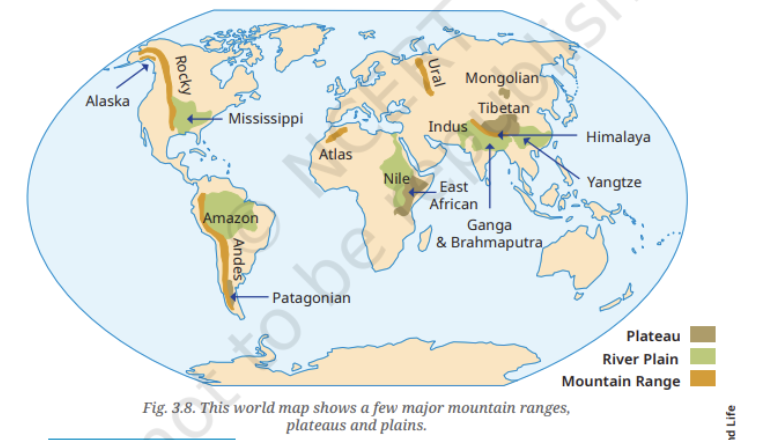
Most of the world’s mountains are grouped in mountain ranges, such as:
- The Himalayas in Asia,
- The Alps in Europe
- The Andes in South America
Some of these ranges stretch for thousands of kilometres.
| Mountain | Location | ||
| Mt. Everest | Between Tibet (China) & Nepal | Two highest peaks of the Himalayan range. | |
| Mt. Kanchenjunga | Between Nepal and & Sikkim | ||
| Mt. Aconcagua | South America | Highest peak of the Andes. | |
| Mt. Kilimanjaro | Eastern Africa | Isolated mountain that is not part of any range. | |
| Mt. Blanc | Western Europe | Highest mountain of the Alps | |
| Mt. Anamudi (Anai Peak) | Kerala | Highest mountain in south India. |
Types of mountains:
| Younger mountains | Older Mountains | ||
| 1 | They are relatively ‘young’, which means that they were formed recently in the Earth’s history. (millions of years) | 1 | They are much older and have been rounded by erosion. |
| 2 | These mountains have tall and sharp peaks | 2 | These mountains and hills are shorter and more rounded. |
| 3 | Upliftment as well as erosion continues to this day. | 3 | Erosion continues to this day. |
| 4 | E.g. Himalayas | 4 | E.g Aravalli range |
Mountain Flora:
- Mountain slopes are often covered with a type of forest called montane forest, where conifer trees such as pines, firs, spruce and deodar are common.
- These conifer trees grow tall and cone-shaped, with thin, pointed leaves.
- At higher altitudes, the trees give way to grasses, mosses and lichen.
Mountain Fauna:
Deep forests, flowing rivers, lakes, grasslands and caves in the mountains are home to diverse fauna, for instance:
| Golden eaglePeregrine falconCanadian lynx Snow leopardIbex | Himalayan tahr Mountain hareYak Grey fox Black bear |

Mountain Rivers:
- Ganga:
- ‘Ganga’ is the Indian name of the largest river originating in the Himalayas.
- In English, ‘Ganges’ is also used.
- Nearly 2,500 km long, this river has numerous tributaries (that is, other rivers joining it).
- Rivers Yamuna and the Ghagara, also originate in the Himalayas.
- River Son or Sone, originates from the Vindhya Range to the south of the Ganga plain.
Mountain Life:
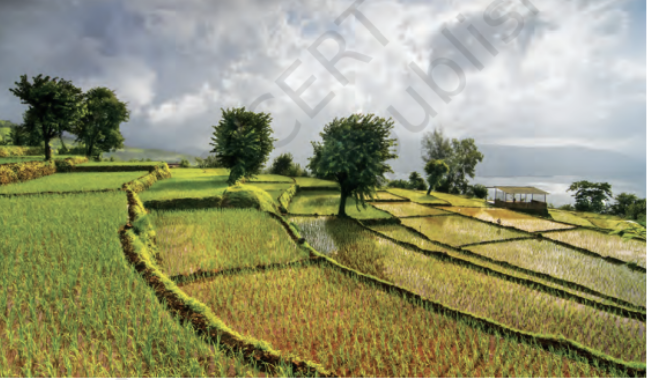
- Terrace Farming (Defn):
- The mountain terrain is usually rugged or rough, and has steep slopes.
- This means that regular farming can only be practised in some valleys.
- Cultivation is practised on the slopes by cutting steps into the slope. This is called terrace farming.
- Herding: In many mountainous regions of the world, herding is the preferred occupation over agriculture.
- Tourism:
- Tourism is often an important source of income for the people living in the mountains.
- The crisp mountain air and scenic beauty attract many tourists.
- Some tourists also go to the mountains for sports such as skiing, hiking, mountaineering and paragliding.
- For many centuries, people have also travelled to these uplands for pilgrimages to holy sites.
Mountaineering:
Bachendri Pal
- Started climbing mountains from a young age
- Led many women’s climbing expeditions.
- She was the first Indian woman to climb Mount Everest in 1984.
- She was awarded Padma Shri in 1984 and Padma Bhushan in 2019.
Arunima Sinha
- She lost a leg in an accident when she was 31.
- With Bachendri Pals encouragement and training, she managed to climb Mount Everest in 2011
- She went on to climb the highest peak of every continent, including Mount Vinson in Antarctica!
- She was awarded Padma Shri in 2015.
Mountain- Cultural significance:
- Significance of Mountains in Ancient India:
- Here are two verses from a long poem Kumārasambhava by Kālidāsa, who lived at least 1,500 years ago and is often considered to be the greatest poet of ancient India.
- The poem, begins with an invocation to the Himalayas (This is a simplified translation from the Sanskrit.)
In the north rises Himalaya, the Lord of mountains, like a living god, who measures the Earth and stretches from the western to the eastern oceans….
From it the wind comes down, carrying spray from descending Ganga shaking the deodar trees, opening the peacocks’ tail feathers and cooling the mountain people after they hunt deer.
- Many traditional communities around the world consider mountains to be sacred places and worship them, such as:
- Mount Everest:
- Mount Everest, the highest mountain in the world at 8,849 m, has many names.
- Tibetans call it ‘Chomolungma’, which means “Mother Goddess of the World’ and worship the mountain.
- Nepalis call it Sagarmatha, meaning “Goddess of the Sky.”
- Mount Kailash: Mount Kailash in Tibet is held sacred by followers of Hinduism, Buddhism, Jainism and Bon (an ancient Tibetan religion).
- Mount Everest:
PLATEAUS
Plateau (Defn):
- A plateau is a landform that rises up from the surrounding land and has a more or less flat surface; some of its sides are often steep slopes.
- Like mountains, plateaus can be young or old in terms of the Earth’s history.
- The height of plateaus can vary from a few hundred metres to several thousand metres.
Examples of plateaus:
- Tibetan Plateau:
- The largest and highest plateau in the world.
- The Tibetan Plateau has average altitude of 4,500m.
- It has nickname ‘Roof of the World’.
- From east to west, it is nearly 2,500 km long (distance from Chandigarh to Kanyakumari)
- Deccan Plateau:
- The Deccan Plateaus of central and the south India is one of the oldest plateaus in the world.
- It is formed through volcanic activity millions of years ago.
Mining:
- Plateaus are rich in mineral deposits; hence they have been called ‘storehouses of minerals.
- Mining is a major activity on plateaus, where many of the world’s largest mines are found.
- Examples:
- East African Plateau is famous for gold and diamond mining
- In India iron, coal and manganese are found in Chhota Nagpur Plateau.
Soil in Plateau:
- The plateau environment is very diverse across the world.
- Many plateaus have a rocky soil, which makes them less fertile than plains and therefore less favourable to farming.
- An exception is that of lava plateaus (that is, formed through volcanic activity), as they often have a rich black soil.
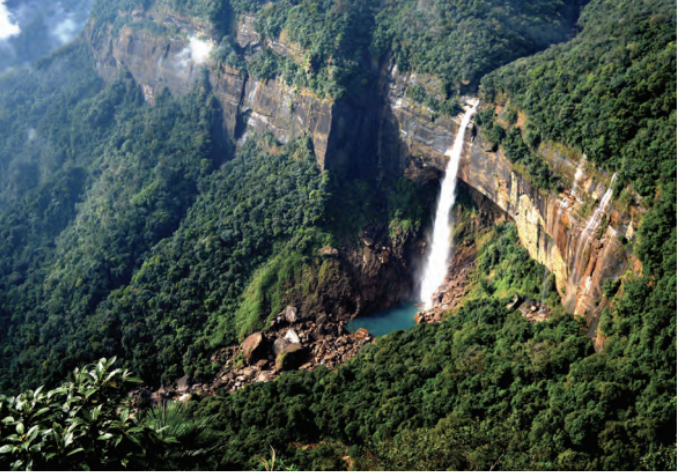
Waterfalls:
Plateaus are also home to many spectacular waterfalls.
| Falls | River | Place | |
| The Victoria falls | Zambezi river | Southern Africa | |
| Hundru falls | Subarnarekha river | Chhota nagpur plateau | |
| Jog falls | Sharavati river | Western ghats | |
| Nohkalikai falls(340m drop) | It is not on a river but is fed by rain water collected on the plateau | Cherrapunji plateau (in Meghalaya). |
PLAINS
Plains (Defn):
- Plains are landforms that have an extensive flat or gently undulating surface.
- They do not have any large hills or deep valleys.
- They are generally not more than 300 metres above sea level.
- Plains also support a variety of flora and fauna.
Floodplains:
- (Defn): Floodplains are one type of plains formed by rivers originating in mountain range where they collect particles of rock, sand and silt called ‘sediments’
- These sediments are carried all the way to the plains, where the rivers deposit them, making the soil very fertile.
- As a result, these plains are ideal for growing crops of all kinds, and agriculture is a major economic occupation in this landform.

Life in the plains:
- Thousands of years ago, the first civilisations developed around rivers in fertile plains.
- In our times too, a large part of the world’s population lives in plains.
- About 40 crore people, more than one-fourth of the total Indian population, live in India’s Ganga plain (often called the ‘Gangetic plain’).
- River Navigation: Because plains have a gentle slope, river navigation is easy and supports a lot of economic activities. In earlier days, people also used rivers extensively to travel from one place to another. Even today there are stretches along the Ganga where people prefer to use boats to move around!
Occupations of people in Ganga plain:
- River fishing
- Agriculture:
- Rice, wheat, maize, barley and millets are grown here
- Fibre crops like cotton, jute and hemp are grown here.
Irrigation:
- Traditional agriculture has been mostly rain-fed (that is, watered through rainfall).
- In recent decades, however, agriculture has turned to irrigation, with water brought to the fields through networks of canals or pumped from groundwater.
What are the problems affecting Ganga plain?
- While irrigation has increased agricultural production, it has also contributed to the depletion (or decrease) of groundwater. This presents a challenge for the future of agriculture in the region.
- Some of the other problems affecting the Ganga plains include high population and pollution.
Plains – Cultural significance:
- Whether in mountain ranges or plains, rivers around the world have carried immense cultural value.
- Many communities have considered a river’s source and its confluence with one or two other rivers to be sacred.
- In India, numerous festivals, ceremonies and rituals are conducted at such locations.
DESERTS
Desserts (Defn): Deserts are considered to be large and dry expanses with very little precipitation. Their flora and fauna are also unique.
Examples:
- Hot Desserts:
- Sahara Desert in Africa
- Thar Desert in the northwest of the Indian Subcontinent.
- Cold Desserts:
- Gobi Desert in Asia.
- Some experts also describe the Antarctica continent as a desert.
Five landscapes (tinais of ancient tamil poetry):
The five tiṇais of ancient Tamil Sangam poetry are five landscapes associated with certain specific deities, lifestyles, moods or emotions (such as love, longing, separation, quarrel, etc.). The characteristics of the five landscapes and the main human occupations:
| Tinai | Landscape | Main occupation | |
| Kuriñji | Mountainous regions | Hunting and gathering | |
| Mullai | Grassland and forests | Cattle rearing | |
| Marudam | Fertile agricultural plains | Farming | |
| Neydal | Coastal regions | Fishing and seafaring | |
| Palai | Arid, desert-like regions | Journeying and fighting |

DEFINITIONS:
- Altitude: The height of an object above sea level. Examples: the altitude of a mountain, the altitude of a bird or plane in flight, the altitude of a satellite.
- Precipitation: Water from the atmosphere reaching the ground in any form is called precipitation. Rain, snow and hail are the most common forms of precipitation.
- Montane forest: A type of forests that grows in mountain regions.
- Moss: A small green plant without flowers or true roots, often spreading in a cushion-like cover.
- Lichen: A plant-like organism that generally clings to rocks, walls or tree.
- Terrain: A piece of stretch of land, from the point of view of its physical features.
- Valley: A lower area between hills, or mountains, often with a river or stream.
- Flash flood: A sudden local flood, often caused by a cloudburst
- Landslide: The sudden collapse of a mass of earth or rock from a mountainside.
- Avalanche: The sudden fall of snow, ice or rocks from a mountainside; often occurs when the snow starts melting.
- Cloudburst: A sudden violent rainstorm.
- Sea level: The average level of the surface of the oceans, also called ‘mean sea level’.
- Confluence: The meeting point of two or more rivers.
- Resilience: The capacity to meet challenges and difficulties, adapt to them or overcome them.
QUESTION AND ANSWERS
Assertion-Reason Questions:
a) Both A and R are true, and R is the correct explanation of A.
b) Both A and R are true, but R is not the correct explanation of A.
c) A is true, but R is false.
d) A is false, but R is true.
- Assertion (A): Mountains with tall and sharp peaks, like the Himalayas, a relatively ‘young’.
Reason (R): They are formed recently in the Earth’s history but that is still millions of years ago.
Ans) a)
- Assertion (A): Mountains are often home to diverse fauna.
Reason (R): The rugged terrain and climate create various habitats.
Ans) a)
- Assertion (A): Plateaus are generally more fertile than plains.
Reason (R): Plateaus have flat surfaces that are easy for farming.
Ans) d)
- Assertion (A): The Ganga plain supports a large population.
Reason (R): It has rich agricultural land.
Ans) a)
- Assertion (A): Snow can be found only in the Himalayas in India.
Reason (R): Snow forms at high altitudes where temperatures are low.
Ans) a)
Answer the following questions:
1. What is a plateau?
2. What is terrace farming?
3. Name some common Montane forest trees.
4. Name the tributaries of Ganga River.
5. Explain the life in the mountains
1 MARK QUESTION
1. What is a landform?
2. Name the highest peak of the Andes.
3. What type of forest is found on mountain slopes?
4. What is the altitude of the Tibetan Plateau?
5. What is the main occupation in the Deccan Plateau?

2 MARK
Q.1) Describe the characteristics of mountains.
Q.2) What are the major economic activities in plateaus?
Q.3). Explain the significance of the Ganga plain for human civilization.
Q.4) What are the differences between young and old mountains?
Q.5) Discuss the impact of tourism on mountain environments.
Ans) Tourism has both positive and negative impacts on India’s mountain environments.
- Boosts Local Economy: Tourism provides jobs and income for local people through hotels, transport, and guiding services.
- Environmental Damage: Overcrowding and littering harm fragile ecosystems, like in the Himalayas.
- Pressure on Resources: Increased tourism uses a lot of water, energy, and land, often straining local resources.
- Cultural Impact: Tourism helps spread awareness of local cultures but can also lead to commercialization.
- Climate Change Effects: More vehicles and construction contribute to pollution, affecting glaciers and mountain air quality.
3 MARK QUESTIONS
Q.1) Discuss the role of mountains in the water cycle.
Ans)
- Unless you live in a Himalayan region (such as Kashmir, Ladakh, Himachal Pradesh, Uttarakhand, Sikkim, Arunachal Pradesh), you may never have seen snow!
- In the rest of India, most precipitation is in the form of rain and hail.
- But at higher altitudes, if it is cold enough, snow will fall, covering the landscape in a soft and beautiful white blanket.
- Snow and hailstones are nothing but precipitation of water in a solid state.
Q.2) Analyse the advantages and disadvantages of farming in the Ganga plain.
Ans)
Advantages:
- Due to sediments like of rock, sand and silt carried by the river Ganga and deposited in the plains, these plains are ideal for growing crops of all kinds, and agriculture is a major economic occupation in this landform.
- Crops like Rice, wheat, maize, barley and millets are grown here. Also Fibre crops like cotton, jute and hemp are grown here.
Disadvantages:
- While irrigation has increased agricultural production, it has also contributed to the depletion (or decrease) of groundwater. This presents a challenge for the future of agriculture in the region.
- Some of the other problems affecting the Ganga plains include high population and pollution.
Q.3) Compare and contrast the environments of mountains and plateaus.
| Mountains | Plateaus | |
| Definition | Mountains are landforms that are much higher than the surrounding landscape. They can be recognised by a broad base, steep slopes and a narrow summit. | A plateau is a landform that rises up from the surrounding land and has a more or less flat surface; some of its sides are often steep slopes. |
| Climate | Mountains are cooler and can have snow. | Plateaus often have moderate to dry climates. |
| Vegetation | Mountain slopes are often covered with a type of forest called montane forest. | Plateaus typically have grasslands or sparse vegetation. |
| Resources | Mountains are important for water sources and forests. | Plateaus are rich in minerals (Mining). |
| Human Habitation | Mountains are less populated due to harsh conditions | Plateaus are comparatively more populated |
Q.4) Explain the cultural significance of landforms in various societies.
Ans)
- Mountains:
- Mountains are often considered sacred in many cultures.
- In ancient India, Kālidāsa’s poem Kumārasambhava praises the Himalayas for their majesty and spiritual importance.
- Mount Everest is called Chomolungma by Tibetans, meaning “Mother Goddess of the World,” and Sagarmatha by Nepalis, meaning “Goddess of the Sky.” Both groups revere it deeply.
- Mount Kailash in Tibet is sacred in Hinduism, Buddhism, Jainism, and Bon traditions.
- Rivers:
- Many communities have considered a river’s source and its confluence with one or two other rivers to be sacred.
- In India, numerous festivals, ceremonies and rituals are conducted at such locations.
- Five landscapes (tinais of ancient tamil poetry):
The five tiṇais of ancient Tamil Sangam poetry are five landscapes associated with certain specific deities, lifestyles, moods or emotions (such as love, longing, separation, quarrel, etc.)
| Tinai | Landscape | Main occupation | |
| 1 | Kuriñji | Mountainous regions | Hunting and gathering |
| 2 | Mullai | Grassland and forests | Cattle rearing |
| 3 | Marudam | Fertile agricultural plains | Farming |
| 4 | Neydal | Coastal regions | Fishing and seafaring |
| 5 | Palai | Arid, desert-like regions | Journeying and fighting |
Thanks a lot for visiting my blog. Please do ‘★ LIKE’ the post if you found it to be useful. Your comments, suggestions, criticism and all opinions are very much appreciated. Please do write your queries in the Reply/comments section and I will try to get back to you asap.

All the content on this blog is copyrighted. It takes immense research, hard work, patience and time to come up with a comprehensive article/post. If you like and need to use any of my article(s) or any part of it, please do give the requisite reference, link or credit to my website/blog . DO NOT COPY WITHOUT PERMISSION.
 Raising Twins™
Very useful educational materials. Thanks for sharing..
LikeLike
Thank you for your kind feedback 😊
LikeLiked by 1 person