


CBSE Class 6 Science – Exploring Society:
India and Beyond – Takshila-DPS Pune- Patna-Coimbatore

AUTHOR
MBBS, DNB (DVL)
Dermatologist, Cosmetologist and Laser Surgeon
Nuleaf Skin Clinic and Hair Transplant Center, Undri, Pune
As a mother of twin daughters and a Consultant Dermatologist based in Undri, Pune, life is always a balancing act. Between busy clinic hours, parenting duties, and everyday chaos, I’ve been creating study notes since Class 4 to help my girls understand and revise their lessons better. Over the years, these weekend study sessions turned into a special tradition—discussing topics taught in school and turning them into organized, easy-to-revise notes.
The notes I’m sharing here are from the 2024–25 academic year of DPS Pune – Patna – Coimbatore, and cover Class 6 chapters. They include all the key points that are likely to be asked in exams, compiled from the Class 6 Exploring Society:India and Beyond , school study materials, class notes and school revision sheets.
Each page was made with care, love, and a hope to make learning feel a little easier—especially during exam time. If they help your child too, then this effort finds even more meaning.
If you find these notes useful, I’d love to hear from you in the comments section. And if you’d like me to upload notes on any particular topic from Class 6, feel free to send in your suggestions.
Don’t forget to subscribe to my blog for new updates, notes, and posts.Wishing you and your child a wonderful academic year ahead!
Warmly,
Gauri
Mom to twins
IMPORTANT POINTS
- The Vedas are the most ancient texts of India and the world.
- Rig Veda, is the most ancient of the four Vedas.
- Experts have proposed that the Rig Veda was composed around 5th to the 2nd millennium BCE.
- One of the best sources of Ancient Indian history is Vedic history.
- Indian culture, by any estimate, is several millenniums old.
- Indian culture consists of art, literature, science, medicine, religion, the art of governance, martial arts, and so on.
- There are also ‘schools of thought’, by whom we mean groups of thinkers or spiritual seekers who share similar ideas about human life, the world, etc.
- Many archaeologists and scholars have pointed out that some of India’s cultural roots go all the way to the Indus or Harappan or Sindhu-Sarasvatī civilisation.
NOTES
THE VEDAS AND VEDIC CULTURE
Vedas:
Vedas (Defn): The word “Veda” comes from the Sanskrit ‘vid’ which means ‘knowledge’ (hence vidyā, for instance). There are four types of Vedas Rigveda, Samaveda, Yajurveda, and Atharvaveda.
Extra points:
- One of the best sources of Ancient Indian History is Vedic literature.
- Vedas have formed the Indian scripture.
- The ideas and practices of Vedic religion are codified by the Vedas and they also form the basis of classical Hinduism.
Types of Vedas:
| Name of the Veda | Key Features of the Veda |
| Rig Veda | The earliest form of Veda |
| Samaveda | The earliest reference for singing |
| Yajurveda | It is also called the book of prayers |
| Atharvaveda | The book of magic and charms |
Hymns of the Vedas:
- Hymns: The Vedas consist of thousands of hymns which were prayers in the form of poems and songs and were recited orally, not written.
- Region: Those hymns were composed in the Sapta Sindhava region (Land of seven rivers).
- Composed by: The Vedic hymns were composed by rishis (male seers or sages) and rishikas (female ones).
- Language: Composed in an early form of the Sanskrit language.
- Deities: They were addressed in poetical form to many deities (gods or goddesses), such as Indra, Agni, Varuṇa, Mitra, Sarasvatī, Uṣhas, and many more.
- Significance:
- These deities together with the seers, maintained ṛitam (truth) and order in human life and in the ‘cosmos’ (universe).
- The early rishis and rishikas saw those gods and goddesses as one, not separate beings.
- Key values, especially ‘Truth’ (often equated with God), were highly important.
- The final verses of the Ṛig Veda called for unity among people.
Q) Why, in 2008, UNESCO recognised Vedic chanting as ‘a masterpiece of the oral and intangible heritage of humanity’?
Ans)
- Experts have proposed that the Rig Veda was composed around 5th to the 2nd millennium BCE.
- So, for 100 to 200 generations, these texts have been committed to memory through rigorous training and passed on orally with hardly any alterations.
- This meticulous transmission over thousands of years explains why, in 2008, UNESCO recognised Vedic chanting as ‘a masterpiece of the oral and intangible heritage of humanity’.
Vedic society
- Janas: Early Vedic society was made up of different janas or ‘clans,’ which were large groups of people.
- Number: The Ṛig Veda lists over 30 such clans, including the Bharatas, Purus, Kurus, Yadus, and Turvaśhas.
- Region: Each clan was linked to a specific region in the northwest part of the Indian subcontinent.
- Governance: We don’t know much about how these clans governed themselves, but the Vedas mention a few terms like rājā (king or ruler), sabhā and samiti (assemblies or gatherings).
- Professions: The Vedic texts mention many different professions, such as farmers, weavers, potters, builders, carpenters, healers, dancers, barbers, and priests.
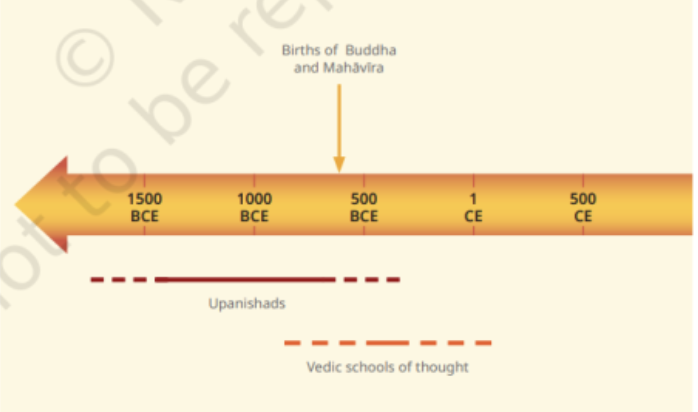
Vedic schools of thought
- Rituals:
- Vedic culture developed many rituals (called yajña or ‘yagya’) aimed at pleasing various gods and goddesses for personal or collective well-being.
- Daily rituals often involved prayers and offerings to Agni, the god of fire, but these rituals became more complex over time.
- Upanishads:
- The Upanishads are part of the larger collection of Vedas.
- They are found at the end of the Vedas and focus on wisdom and knowledge.
- They are built upon Vedic concepts, such as rebirth (repeated cycles of birth and death) and karma (our actions and their results).
- The Upaniṣhads also introduced the concept of ātman or Self — the divine essence that resides in every being but is ultimately one with brahman (the ultimate reality).
- Upanishads teach us that everything in this world is connected and interdependent.
- Vedanta: One Vedic school of thought, called Vedanta, teaches that everything — human life, nature, and the universe — is part of one divine essence called brahman* or simply tat (‘that’)
*not to be confused with the god Brahmā
- Yoga: By the 1st millennium BCE, new schools of thought arose from the Vedas, one of which was Yoga, which developed practices to help people realize brahman in their consciousness.
Together, these schools of thought became the foundations for what we call ‘Hinduism’ today.
Buddhism
Buddhism, another schools of thought, emerged, which did not accept the authority of the Vedas and developed their own system.
About Gautam Buddha:
- About 2,500 years ago (around 560 BCE), a prince named Siddhārtha Gautama was born in Lumbini (modern-day Nepal).
- As the story goes, then, Siddhārtha Gautama grew up living a protected life in the palace. One day, at the age of 29, he asked to be driven through the city in a chariot, and for the first time in his life came across an old man, a sick man, and a dead body. He also saw an ascetic, who appeared to be happy and at peace.
- Following this experience, Siddhārtha decided to give up his palace life, leaving behind his wife and son. Travelling on foot as an ascetic, meeting other ascetics and scholars, he searched for the root cause of suffering in human life.
- After meditating for many days under a pipal tree at Bodh Gaya (today in Bihar), he attained enlightenment; he realised that avidyā (ignorance) and attachment are the source of human suffering and conceived a method to remove these two causes.
- Siddhārtha, then, became known as the ‘Buddha’, which means the ‘enlightened’ or ‘awakened’ one.
Teachings of Buddha:
- Ahimsa: The Buddha started teaching the idea of ahimsa, which is generally translated as ‘nonviolence’, but originally means ‘non-hurting’ or ‘non-injuring’.
- Discipline: He also insisted on a sincere inner discipline.
- Sangha: The Buddha founded the Sangha, a community of bhikṣhus or monks (and, later, bhikṣhuṇīs or nuns) who dedicated themselves to practising and spreading his teachings.
- Influence: His influence on India and Asia was enormous and still continues today.
Jainism
Jainism is another important school of thought that became widespread at the same time, although its roots are said to be much more ancient.
About Mahavira
- Prince Vardhamāna was born into a royal family in the early 6th century BCE.
- His birthplace was near the city of Vaiśhālī, in modern-day Bihar.
- At the age of 30, he decided to leave his home and go in search of spiritual knowledge.
- He practised an ascetic discipline and, after 12 years, achieved ‘infinite knowledge’ or supreme wisdom.
- He became known as ‘Mahāvīra’, or ‘great hero’, and started preaching what he had realised.
Teachings of Jainism:
- Jain: The word ‘Jain’ or jaina comes from jina, meaning ‘conqueror’. This does not refer to the conquest of territory or enemies, but to the conquest of ignorance and attachments, so as to reach enlightenment.
- Jain teachings: include ahimsa, anekāntavāda and aparigraha (influenced by Buddhism and Vedantic school of thought).
- Ahimsa – ‘non-hurting’ or ‘non-injuring’.
- Anekāntavāda
- means ‘not just one’ aspect or perspective.
- That is, the truth has many aspects and cannot be fully described by any single statement.
- Aparigraha
- means ‘non-possession’
- It advises detachment from material possessions, limiting oneself to what is truly necessary in life.
- Jainism also insists on the interconnectedness and interdependence of all creatures, from humans to invisible organisms, as they support each other and cannot live without one another.
- Scientists studying nature, flora and fauna, have again and again confirmed this deep truth.
‘Chārvāka’ school
(Also called ‘Lokāyata’)
- It believed that this material world is the only thing that exists, and therefore there can be no life after death.
- This school did not gain much popularity and it disappeared with time.
Similarities between Jainism and Buddhism
- Monks and nuns began travelling across the land to spread their respective teachings far and wide. Some of them created new monasteries in faraway places. Others led ascetic lives in caves cut in the rock.
- Both Mahavira and Buddha hailed from Royal families.
- Denied the authority of Vedas.
- Taught in the language of common people.
- Admitted disciples from all castes and both the genders.
- Opposed blood sacrifices.
- Believed in the doctrine of karma.
Dissimilarities between Jainism and Buddhism
| Jainism | Buddhism | ||
| 1 | It followed extreme path | 1 | It followed middle path |
| 2 | It remained only in India | 2 | It spread across many parts of the world |
| 3 | It does not believe in the existence of God, but believes in every living being. | 3 | It emphasises on ANATMA (no external soul) and ANITYA (impermanence –nothing lasts) |

Folk and Tribal Roots
Tribe (Defn): A tribe is a group of families or clans that share common ancestry, culture, and language. They live together as a close-knit community, typically under the leadership of a chief, and do not have private property.
Extra points:
- In ancient India, there wasn’t a specific word for ‘tribe’. Tribes were simply different janas (groups) living in specific areas like forests or mountains.
- The Indian Constitution uses the terms ‘tribes’ and ‘tribal communities in English and janjāti in Hindi
- According to official figures, in 2011, India had 705 tribes across most states, with a population of about 104 million people — more than the combined populations of Australia and the United Kingdom!
- In the 19th century, anthropologists often described tribes as ‘primitive’ or ‘inferior’ to more ‘civilized’ people.
- However, with more in-depth studies of tribal cultures, these biased views have mostly been rejected.
- Oral Traditions in India: India has also had rich oral traditions’, that is, teachings or practices transmitted through everyday practice, without written texts. Folk traditions come from common people, while tribal traditions come from specific tribes.
How have such interactions between different belief systems taken place for so long and so naturally? (Folk, tribal, Hinduism)
- Constant Interaction:
- There has been a continuous exchange between folk, tribal, and Hindu belief systems, including deities, concepts, legends, and rituals.
- Mutual Influence of Deities and Worship:
- The god Jagannath, worshipped at Puri (Odisha), was originally a tribal deity but is now part of mainstream Hinduism.
- Various forms of Mother Goddess worship across India also have tribal origins.
- Tribal communities have adopted Hindu deities, and many tribes have their own versions of the Mahābhārata and Rāmāyaṇa, especially in regions like north eastern India and Tamil Nadu.
- Shared Concepts: Folk, tribal, and Hindu belief systems have many similar ideas, which have led to their natural interaction:
- Sacred Nature: All three systems regard elements of nature (mountains, rivers, trees, animals, stones) as sacred, believing they possess consciousness.
- Natural elements: Tribes often worship deities connected to natural elements. For example, Toda tribals of the Nilgiris of Tamil Nadu. Over thirty peaks of this mountain range are residences of a god or a goddess; those peaks are so sacred that the Todas avoid pointing to them with a finger
- Higher Divinity: Despite worshipping many deities, many tribal groups also believe in a supreme being, similar to Hinduism:
- Donyipolo (worshipped by tribes in Arunachal Pradesh) is a supreme god formed from the Sun and Moon.
- Khandoba in parts of central India.
- In eastern India, the Munda and Santhal tribals, among others, worship Singbonga, a supreme deity who created this whole world.
- Mutual Enrichment: Sociologist André Béteille emphasized that tribal religions and Hinduism have mutually influenced each other over time. This has led to a rich exchange of religious practices and ideas, enriching both systems.
DEFINITIONS
- Schools of thought: Schools of thought mean groups of thinkers or spiritual seekers who share similar ideas about human life, the world, etc.
- Vedas: Ancient Indian texts that form the foundation of Vedic culture and philosophy. They consist of hymns, prayers, and rituals.
- Rishis and Rishikas: Male and female seers or sages who composed the Vedic hymns.
- Atman: The concept of the self or soul in Indian philosophy.
- Brahman: The ultimate, unchanging reality composed of pure being and consciousness.
- Karma: The principle of cause and effect where a person’s actions influence their future.
- Ahimsa: Non-violence in action and thought.
- Jana: Ancient term for tribe or community.
- Spiritual: Concerned with the spirit or soul (ātman in Sanskrit and many Indian languages). Spirituality is the search for a deeper or higher dimension beyond our current personality
- Seeker: Someone who seeks the truths of this world. This could be a sage, a saint, a yogi, a philosopher, etc.
- UNESCO: UNESCO stands for ‘United Nations Educational, Scientific and Cultural Organization’. It promotes dialogue between people and nations through education, science and culture.
- Cosmos: The world or the universe as an ordered and harmonious system.
- Worldview: A certain view or understanding of the world, its origin, or its workings.
- Healer: Someone who uses traditional practices to relieve or heal diseases.
- Consciousness: The quality or state of being aware, for instance of something within oneself.
- Ascetic: Someone who engages in a rigorous discipline to attain a higher consciousness.
- Attachment: The condition of having a bond with someone or something, usually through sentiment or habit.
- Monk: A man who, giving up the usual life in the world, dedicates himself to religious or spiritual pursuits. A monk usually takes vows, that is, commits himself to follow strict rules for a disciplined life.
- Nun: The female equivalent of a monk.
Key Figures
- Siddhārtha Gautama (The Buddha): Founder of Buddhism who taught the path to enlightenment and the cessation of suffering.
- Rishi Uddālaka Āruņi: A Vedic sage who taught the concept of Brahman through analogies.
- Nachiketa: A young seeker who learned about the immortality of the soul from Yama, the god of death.
- Gärgi: A female philosopher who debated with Yājñavalkya on the nature of Brahman.
Important Quotations
- “ekam sat viprā bahudhā vadanti” – “The Existent (supreme reality) is one, but sages give it many names.”
- “aham brahmāsmi” – “I am brahman.”
- “tat tvam asi” – “You are that.”
- “sarve bhavantu sukhinah” – “May all creatures be happy” (to be free from disease and sorrow)
- “Not by water is one made pure, though many people may bathe here [in sacred rivers]. But one is pure in whom truth and dharma reside. Conquering oneself is greater than conquering a thousand men on the battlefield a thousand times.” – Buddha
- “All breathing, existing, living, sentient creatures should not be slain, nor treated with violence, nor abused, nor tormented, nor driven away.” – Mahāvīra
- “The thousands of castes and tribes on the Indian subcontinent have influenced each other in their religious beliefs and practices since the beginning of history and before. That the tribal religions have been influenced by Hinduism is widely accepted, but it is equally true that Hinduism, not only in its formative phase but throughout its evolution, has been influenced by tribal religions.” – The Indian sociologist André Béteille
Question Answers
1. How have interactions between different belief systems taken place for so long and so naturally?
Ans) Refer to page 8
- What are the Vedas?
Ans) The word “Veda” comes from the Sanskrit vid which means ‘knowledge’ (hence vidyā, for instance). The Vedas are the most ancient texts of India and the world. There are four types of Vedas Rigveda, Samaveda, Yajurveda, and Atharvaveda.
- What is the significance of Vedic chanting according to UNESCO?
Ans)
- Experts have proposed that the Rig Veda was composed around 5th to the 2nd millennium BCE.
- So, for 100 to 200 generations, these texts have been committed to memory through rigorous training and passed on orally with hardly any alterations.
- This meticulous transmission over thousands of years explains why, in 2008, UNESCO recognised Vedic chanting as ‘a masterpiece of the oral and intangible heritage of humanity’.
4. Discuss the origin and composition of the Vedas.
Ans)
- Vedas (Defn): The word “Veda” comes from the Sanskrit “vid” which means ‘knowledge’ (hence vidyā, for instance). There are four types of Vedas Rigveda, Samaveda, Yajurveda, and Atharvaveda.
- Hymns: The Vedas consist of thousands of hymns which were prayers in the form of poems and songs and were recited orally, not written.
- Region: Those hymns were composed in the Sapta Sindhava region (Land of seven rivers).
- Composed by: The Vedic hymns were composed by rishis (male seers or sages) and rishikas (female ones).
- Language: Composed in an early form of the Sanskrit language.
- Experts have proposed that the Rig Veda was composed around 5th to the 2nd millennium BCE.
- So, for 100 to 200 generations, these texts have been committed to memory through rigorous training and passed on orally with hardly any alterations.
5. Explain the concept of Brahman and atman in Vedic philosophy.
Ans)
- Brahman:
- Brahman is the ultimate, unchanging reality composed of pure being and consciousness.
- Vedanta, teaches that everything — human life, nature, and the universe — is part of one divine essence called brahman* or simply tat (‘that’)
- Atman:
- The concept of the self or soul in Indian philosophy.
- Atman (the Self) is considered the divine essence within every being.
- Mantras:
- The main Upanishadic mantras which signify these are:
- Aham brahmāsmi (“I am Brahman”)
- Tat tvam asi (“You are That”)
- These mantras signify the unity between the individual self and the supreme reality.
- The main Upanishadic mantras which signify these are:
- Upanishads teach us that everything in this world is connected and interdependent.
6.What new schools of thought emerged in India in the 1st millennium BCE? What are their core principles?
Ans)
- Vedanta: Vedanta, a school of thought teaches that everything — human life, nature, and the universe — is part of one divine essence called brahman* or simply tat (‘that’)
- Yoga: By the 1st millennium BCE, new schools of thought arose from the Vedas, one of which was Yoga, which developed practices to help people realize brahman in their consciousness.
- Buddhism:
- Founded by Siddhārtha Gautama, known as the Buddha, who sought to address human suffering.
- Core principles include the Four Noble Truths and the Eightfold Path, advocating a way to overcome ignorance and attachment through ethical conduct, meditation, and wisdom.
- Jainism:
- Founded by Mahāvīra, who emphasized strict non-violence (ahimsa), truth, ‘not just one’ aspect or perspective (Anekāntavāda) and non-possession (aparigraha).
- Jainism also insists on the interconnectedness and interdependence of all creatures.
- Chārvāka (Lokāyata): It believed that this material world is the only thing that exists, and therefore there can be no life after death. This school did not gain much popularity and it disappeared with time.
Assertion-Reason Questions:
a) Both A and R are true, and R is the correct explanation of A.
b) Both A and R are true, but R is not the correct explanation of A.
c) A is true, but R is false.
d) A is false, but R is true.
- Assertion (A): The Vedas are ancient texts of India.
Reason (R): The Vedas consist of prayers and hymns.
- Assertion (A): The Rig Veda is the oldest of the four Vedas.
Reason (R): It was composed in the Sapta Sindhava region.
- Assertion (A): Vedic hymns were composed by rishis.
Reason (R): They were passed down orally.
- Assertion (A): Vedic chanting is recognized by UNESCO.
Reason (R): It is a masterpiece of the oral heritage of humanity.
- Assertion (A): Brahman is a central concept in Vedic philosophy.
Reason (R): It represents the divine essence in everything.
- Assertion (A): The Vedas were composed in an early form of Sanskrit.
Reason (R): Sanskrit was the language used in ancient Indian texts.
10. Assertion (A): Buddhism accepts the authority of the Vedas.
Reason (R): Buddhism originated as a reform movement within Hinduism.
11. Assertion (A): Jainism emphasizes non-violence and non-possessiveness.
Reason (R): These principles are essential for spiritual liberation.
12. Assertion (A): The Charvaka School gained widespread popularity.
Reason (R): Charvaka promotes materialistic views and scepticism about spiritual beliefs.
True-False Questions:
- The word “Veda” means “truth”.
- The Vedic hymns were written down immediately after they were composed.
- Rishis and Rishikas composed the Vedic hymns.
FA3 REVISION SHEET QUESTIONS
1 MARK QUESTIONS
Q.1) What is the significance of the term “ṛitam” in Vedic thought?
Ans)
- The Vedas were addressed in poetical form to many deities (gods or goddesses), such as Indra, Agni, Varuṇa, Mitra, Sarasvatī, Uṣhas, and many more.
- These deities together with the seers, maintained ṛitam (truth) and order in human life and in the ‘cosmos’ (universe).
Q.2) Who is recognized as the ‘Buddha’?
Ans) Siddhārtha Gautama, the Enlightened One, is recognized as the Buddha, who founded Buddhism after attaining spiritual enlightment.
Q.3) What does “karma” mean in Vedic philosophy?
Ans) “Karma” refers to the vedic principle The principle of cause and effect where a person’s actions influence their future.
Q.4) What is the primary teaching of Jainism?
Ans) Jainism emphasizes on the following:
- Ahimsa – ‘non-hurting’ or ‘non-injuring’.
- Anekāntavāda
- means ‘not just one’ aspect or perspective.
- That is, the truth has many aspects and cannot be fully described by any single statement.
- Aparigraha
- means ‘non-possession’
- It advises detachment from material possessions, limiting oneself to what is truly necessary in life.
Q.5) Where was Mahāvīra born?
Ans) Prince Vardhamāna was born into a royal family in the early 6th century BCE. His birthplace was near the city of Vaiśhālī, in modern-day Bihar.
Q.6) Define “Upaniṣhads”.
Ans) The Upaniṣhads are ancient Indian texts that explore philosophical and spiritual concepts, focusing on the ultimate reality (Brahman), the self (Ātman), and the nature of existence.

2 MARK QUESTION
Q.1) Describe the process of Vedic hymn transmission.
Ans)
- Experts have proposed that the Rig Veda was composed around 5th to the 2nd millennium BCE.
- So, for 100 to 200 generations, these texts have been committed to memory through rigorous training and passed on orally with hardly any alterations.
- This meticulous transmission over thousands of years explains why, in 2008, UNESCO recognised Vedic chanting as ‘a masterpiece of the oral and intangible heritage of humanity’.
Q.2) Explain the significance of the Sangha in Buddhism.
Ans)
- The Buddha founded the Sangha, a community of bhikṣhus or monks (and, later, bhikṣhuṇīs or nuns) who dedicated themselves to practising and spreading his teachings.
- Monks and nuns began travelling across the land to spread their respective teachings far and wide. Some of them created new monasteries in faraway places. Others led ascetic lives in caves cut in the rock.
- They helped to spread Buddha’s teachings in India and Asia.
Q.3) What are the key concepts introduced by the Upanishads?
Ans)
- The Upanishads are part of the larger collection of Vedas.
- They are found at the end of the Vedas and focus on wisdom and knowledge.
- They are built upon Vedic concepts, such as rebirth (repeated cycles of birth and death) and karma (our actions and their results).
- The Upaniṣhads also introduced the concept of ātman or Self — the divine essence that resides in every being but is ultimately one with brahman (the ultimate reality). Brahman is the ultimate, unchanging reality composed of pure being and consciousness.
- Upanishads teach us that everything in this world is connected and interdependent.
Q.4) Discuss the role of rituals in Vedic society.
Ans)
- Vedic culture developed many rituals (called yajña or ‘yagya’) aimed at pleasing various gods and goddesses for personal or collective well-being.
- Daily rituals often involved prayers and offerings to Agni, the god of fire, but these rituals became more complex over time.
- The rituals were addressed to many deities (gods or goddesses), such as Indra, Agni, Varuṇa, Mitra, Sarasvatī, Uṣhas, and many more.
Q.5) Compare Buddhism and Jainism in terms of their teachings on non-violence.
Ans)
- Jainism: Non-violence is the most important rule in Jainism. Jains avoid harming any living being, even tiny insects, and take extreme care in daily life, like wearing masks to prevent accidentally killing small creatures.
- Buddhism: Non-violence is also important in Buddhism, but it focuses more on avoiding intentional harm to others and being kind. Buddhists don’t take as many strict precautions as Jains and focus on reducing suffering with compassion and mindfulness.
3 MARK QUESTIONS
Q.1) Discuss the role of women in Vedic society based on the text.
Ans) Women in Vedic society played important roles in family, religion, and education. Here’s a simple summary:
- Education: Women were educated and some, like Gargi and Maitreyi, became famous scholars and thinkers.
- Religious Roles: Women took part in religious ceremonies and sometimes even composed Vedic hymns (rishikas). Goddesses like Saraswati, Usha, and Aditi were highly revered, symbolizing knowledge, dawn, and creation.
- Family Role: They were central to family life, managing the household and raising children with moral values.
- Rights: Women had some property rights and were respected, especially in early Vedic times.
However, over time, their freedom and status declined, with more restrictions emerging in later periods.
Q.2) Explain how Buddhism and Jainism emerged as reactions to Vedic traditions.
Ans) Both the Buddhism and Jainism did not accept the authority of the Vedas and developed their own system.
- Opposition to Rituals: Both religions rejected the elaborate Vedic rituals and sacrifices, e.g blood sacrifices
- Focus on Individual Effort: They prioritized personal discipline and meditation over reliance on priests or rituals. E.g the Buddha taught the Eightfold Path
- Equality in Spirituality: Both Buddhism and Jainism challenged the caste-based restrictions of Vedic society, emphasizing that anyone could seek liberation. E.g Mahāvīra accepted disciples from all castes, and the Buddha’s Sangha included people of all backgrounds.
- Ethical Living: They placed strong emphasis on non-violence, truth, and compassion as the foundation of spiritual life, contrasting with the ritualistic focus of Vedic traditions.
Q.3) Discuss the concept of “truth” in the context of anekāntavāda and its relevance today.
Ans) Anekāntavāda means ‘not just one’ aspect or perspective. That is, the truth has many aspects and cannot be fully described by any single statement.
Here are some simple points:
- Many Perspectives: Different people may see the same thing differently, like the story of the blind men touching different parts of an elephant.
- Encourages Tolerance: It teaches us to respect others’ views, helping avoid fights or misunderstandings.
- Useful Today: For big problems like climate change, listening to all ideas—scientists, businesses, and communities—leads to better solutions.
- Personal Growth: It reminds us that we don’t know everything and should stay open to learning from others.
Anekāntavāda helps us live peacefully and solve problems better by understanding multiple viewpoints.
Q.4) Analyze the significance of Vedic culture in shaping Indian civilization.
Q.5) Evaluate the impact of oral traditions on Indian culture.
Q.6) What are the similarities and differences between Vedic and Buddhist teachings?
Q.7)Illustrate the significance of natural elements in tribal and folk traditions.
Q.8) Analyze how tribal beliefs influenced Hinduism.
Thanks a lot for visiting my blog. Please do ‘★ LIKE’ the post if you found it to be useful. Your comments, suggestions, criticism and all opinions are very much appreciated. Please do write your queries in the Reply/comments section and I will try to get back to you asap.

All the content on this blog is copyrighted. It takes immense research, hard work, patience and time to come up with a comprehensive article/post. If you like and need to use any of my article(s) or any part of it, please do give the requisite reference, link or credit to my website/blog . DO NOT COPY WITHOUT PERMISSION.
 Raising Twins™