

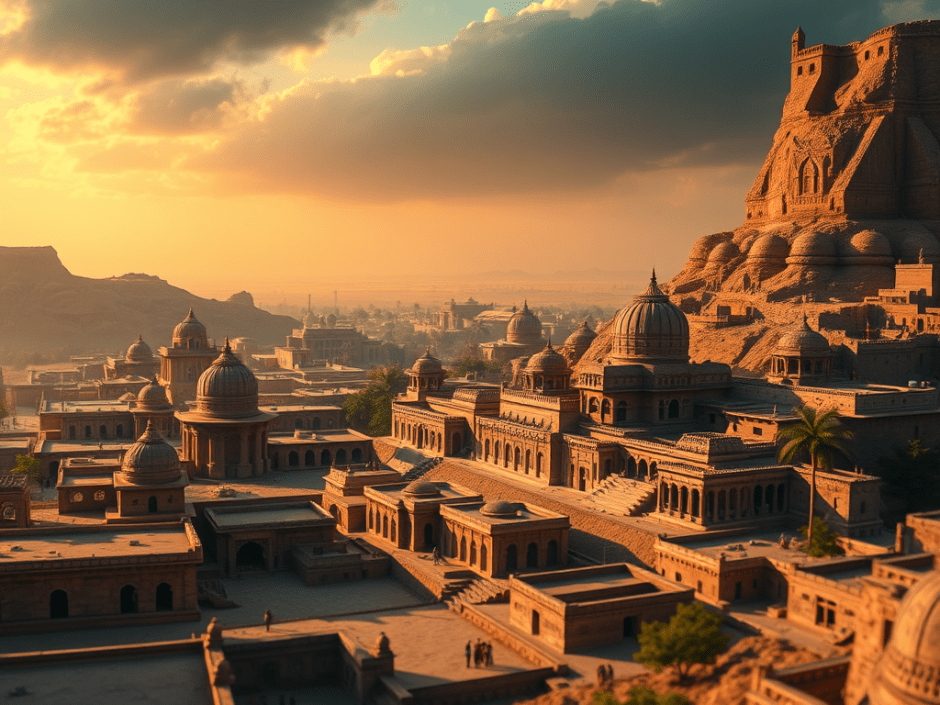
CBSE Class 6 Science – Exploring Society:India and Beyond – Takshila-DPS Pune- Patna-Coimbatore

AUTHOR
MBBS, DNB (DVL)
Dermatologist, Cosmetologist and Laser Surgeon
Nuleaf Skin Clinic and Hair Transplant Center, Undri, Pune
As a mother of twin daughters and a Consultant Dermatologist based in Undri, Pune, life is always a balancing act. Between busy clinic hours, parenting duties, and everyday chaos, I’ve been creating study notes since Class 4 to help my girls understand and revise their lessons better. Over the years, these weekend study sessions turned into a special tradition—discussing topics taught in school and turning them into organized, easy-to-revise notes.
The notes I’m sharing here are from the 2024–25 academic year of DPS Pune – Patna – Coimbatore, and cover Class 6 chapters. They include all the key points that are likely to be asked in exams, compiled from the Class 6 Exploring Society:India and Beyond , school study materials, class notes and school revision sheets.
Each page was made with care, love, and a hope to make learning feel a little easier—especially during exam time. If they help your child too, then this effort finds even more meaning.
If you find these notes useful, I’d love to hear from you in the comments section. And if you’d like me to upload notes on any particular topic from Class 6, feel free to send in your suggestions.
Don’t forget to subscribe to my blog for new updates, notes, and posts.Wishing you and your child a wonderful academic year ahead!
Warmly,
Gauri
Mom to twins
IMPORTANT POINTS
- Harappa and Mohenjo-daro, now in Pakistan, were the first two cities of this civilisation to be discovered; their identification goes back to 1924, a century ago.
- Several sites followed in the Indus plains, which is why the civilisation was initially called ‘Indus Valley civilisation’.
| Harappan cities | Modern state/ region | |
| Important cities of Indus civilisation: | ||
| 1 | Harappa | Punjab (Pakistan) |
| 2 | Mohenjo Daro | Sindh (Pakistan) |
| 3 | Dholavira | Gujarat |
| 4 | Rakhigarhi | Haryana |
| 5 | Ganweriwala | Cholistan desert of Pakistan |
| 6 | Lothal | Gujarat |
| Important cities of Sarasvatī basin: | ||
| 1 | Rakhigarhi and Ganweriwala | |
| 2 | Farmana | Haryana |
| 3 | Kalibangan | Rajasthan |
| 4 | Bhirrana and Banawali | Haryana |
NOTES
CIVILIZATION
Civilization (Defn): The advanced stage of human societies is called Civilization
Q.1) What are the characteristics of a civilization?
- Government and administration: Presence of some form of government and administration to manage a more complex society and its many activities.
- Urbanism: Town-planning, the growth of cities and their management, which generally includes water management and a drainage system.
- Trade: Trade both internal (within a city or a region) and external (with distant regions or other parts of the world) — to exchange all sorts of goods
- Writing: Some form of writing — needed to keep records and to communicate.
- Variety of crafts : including the management of raw materials (such as stone or metal) and the production of finished goods (such as ornaments and tools)
- Cultural Ideas: cultural ideas about life and the world, expressed through art, architecture, literature, oral traditions or social customs.
- Productive agriculture: a productive agriculture — enough to feed not just the villages, but also the cities.
When did civilisation begin?
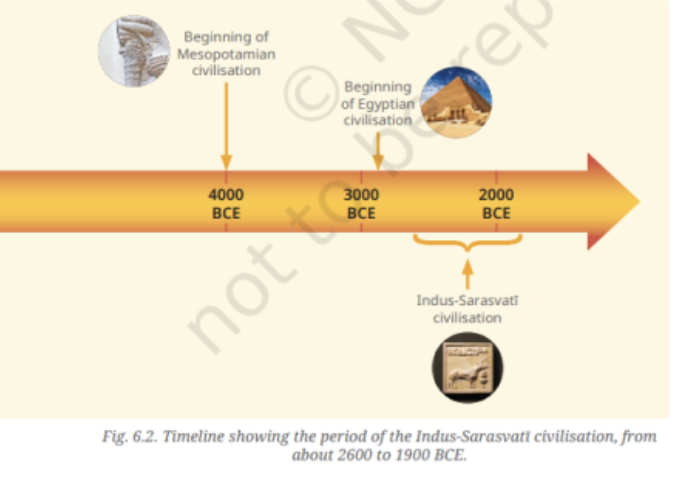
Mesopotamia🡪 Modern Iraq and Syria
Indus Valley Civilization🡪 2600 to 1900 BCE
Q.2) Describe the ‘First Urbanisation of India’.
Ans)
- The vast plains of Punjab (today divided between India and Pakistan) and Sindh (now in Pakistan) are watered by the Indus River and its tributaries. This made those plains fertile and, therefore, favourable to agriculture.
- A little further east, a few millenniums ago, another river, the Sarasvatī, used to flow from the foothills of the Himalayas through Haryana, Punjab, parts of Rajasthan and Gujarat.
- In this whole region, from about 3500 BCE, villages grew into towns, and with increasing trade and other exchanges, those towns further grew into cities. This transition happened around 2600 BCE.
- Archaeologists gave this civilisation several names — ‘Indus’, ‘Harappan’, ‘Indus-Sarasvatī’ or ‘Sindhu-Sarasvatī’ civilisation.
- Its inhabitants are called ‘Harappans’. It is one of the oldest civilisations in the world.
Q.3) Why are the inhabitants of this civilisation called ‘Harappans’ today?
Ans) The inhabitants of this civilisation called ‘Harappans’ because the city of Harappa (today in Pakistan’s Punjab) was the first of this civilisation to be excavated, way back in 1920–21, over a century ago.
Q.4) Write a short note on the Sarasvatī River.
Ans)
- Important cities grew along the Indus (or Sindhu) and its five main tributaries, such as Mohenjo-daro and Harappa.
- There are many sites along the Sarasvatī River, which today goes by the name of ‘Ghaggar’ in India and ‘Hakra’ in Pakistan (hence the name ‘Ghaggar-Hakra River’). This river is now seasonal, because it flows only during the rainy season.
- The Sarasvatī River is first mentioned in the Rig Veda, an ancient collection of prayers.
- In this text, Sarasvatī is worshipped both as a goddess and as a river flowing ‘from the mountain to the sea’. Later texts describe the river as drying up and eventually disappearing.
Q.5) Why the term ‘Valley is not used anymore?
Ans) The term ‘Valley’ is obsolete, as we now know that the civilisation extended much beyond the Indus region.
Q.6) Write about the planning of the Harappan cities.
Ans)
- The larger Harappan cities were built according to precise plans.
- They had wide streets which were often oriented to the cardinal directions.
- Most cities seem to have been surrounded by fortifications
- Cities had two distinct parts —
- the ‘upper town’, where the local elite probably lived,
- and the ‘lower town’, where common people lived.
- Some large buildings were used for collective purposes like warehouses, where goods to be transported were stored.
- Individual houses of various sizes lined the streets and smaller lanes.
- The quality of construction was the same for small and big houses.
- All the buildings were generally made of bricks.

Q.7) Give details about ‘The Great Bath’.
Ans)
- The great bath was a small but elaborate tank.
- It measured about 12 x 7 metres.
- It had waterproofing materials (such as natural bitumen, a form of tar) applied on top of carefully laid-out bricks.
- The tank was surrounded by small rooms, one of which contained a well.
- There was a drain in one corner of the tank to empty it from time to time and refill it with fresh water.
Q.8) What was the purpose of “The great bath’?
Ans) Archaeologists have proposed several possible interpretations — a public bath for people; a bath for the royal family only; or a tank used for religious rituals. The first interpretation is now ruled out because it turns out that in this city, most houses had individual bathrooms.
Q.9) Describe the water management in the Harappan sites. Give examples.
Ans)
- The Harappans gave much importance to water management and cleanliness.
- They often had separate areas for bathing in their homes; these were connected to a larger network of drains, which generally ran below the streets and took the waste water away.
- In Mohenjo-daro, people drew water from hundreds of wells made of bricks.
- But in other regions, it may have been from ponds, nearby streams or human-made reservoirs.
Q.10) Write two points about the water management in Dholavira and one point about housing.
Ans)
- In the case of Dholavira (in the Rann of Kutch in Gujarat), the largest reservoir measured 73 metres in length.
- At Dholavira, at least six large reservoirs were built with stones or even cut into the rock. Most of them were connected through underground drains for efficient water harvesting and distribution.
- Housing area in Dholavira, had perpendicular streets. Dholavira had three distinct zones, not two as in other cities. The foundations of most buildings were made with stones.
What Did the Harappans Eat?
Q.11) Why did the Harappans settle along the banks of the rivers?
Ans) The Harappans created many of their settlements along the banks of large or small rivers not just for easy access to water, but also for agriculture, since rivers enrich the soil around them.
Q.12) What food did the Harappans consume?
Ans)
- The Harappans grew cereals like barley, wheat, some millet, and sometimes rice, in addition to pulses and a variety of vegetables.
- They were also the first in Eurasia to grow cotton, which they used to weave into clothes.
- The Harappans also domesticated a number of animals for meat consumption and fished both in rivers and in the sea. This is known from the large numbers of animal and fish bones found during excavations.
Q.13) What were the farming tools used by Harappans?
Ans) They made farming tools, including the plough some of which continue to be used by modern day farmers.
Q.14) What did Harappan cooking pots contain?
Ans) Harappan cooking pots contained remains of dairy products, turmeric, ginger and banana.
Q.15) How was the agriculture managed?
Ans) This intense agricultural activity was managed by hundreds of small rural sites or villages. Then as now, the cities could survive only if enough agricultural produce from rural areas reached them on a daily basis.
Q.16) How did the Harappans make Bronze?
Ans)
- The Harappans mastered the art of working copper, a soft metal.
- If tin is added to copper, the resulting metal is bronze, which is harder than copper.
- The Harappans used bronze to make tools, pots and pans, and some figurines.
Brisk Trade
Q.17) Write in detail about the Harappan trade with other civilisations.
Ans)
- The Harappans were engaged in active trade, not only within their own civilisation (other cities nearby or far away), but with other civilisations and cultures within and outside India.
- They exported ornaments, timber, some objects of daily use, probably also gold and cotton, and possibly some food items.
- The most favoured ornaments were beads of carnelian, a reddish semiprecious stone found mostly in Gujarat. Harappan craftspeople developed special techniques to drill them, so a string could pass through them, and to decorate them in various ways.
- They also worked conch shells into beautiful shell bangles
- The Harappans probably bought copper in exchange of the exported goods
- To conduct such a trade, they used land routes and rivers, and the sea for more distant destinations — this is the first intensive maritime activity in India.
Q.18) Describe a Harappan settlements located in the coastal regions of Gujarat and Sindh.
Ans)
- Lothal, a small settlement in Gujarat, has a surprisingly huge basin measuring 217 metres in length and 36 metres in width — the length is just a little more than that of two football grounds!
- This basin must have been a dockyard, that is, a structure used to receive and send boats for further transportation of goods.
Q.19) What are Seals? What were they used for?
Ans)
- The huge trade in the Indus Civilisation required traders to be able to identify their goods — and also each other! This seems to have been the chief purpose of thousands of small seals, which have been excavated from many settlements.
- These seals were generally made of steatite, a soft stone that would be hardened through heating.
- They measure only a few centimetres and generally depict animal figures with, above them, a few signs that are part of a writing system.

The End or a New Beginning?
Q.20) Describe the changes see around 3900 years ago (around 1900 BCE)
Ans)
- Around 1900 BCE, this Sindhu-Sarasvatī civilisation, despite all its achievements, began to fall apart.
- The cities were abandoned one by one.
- If any inhabitants remained, they adopted a rural lifestyle in the changed environment — it appears that the earlier government or administration no longer existed.
- Gradually the Harappans scattered over hundreds, if not thousands, of small rural settlements.
Q.21) What caused this decline?
Archaeologists have proposed many factors.
Two factors are currently agreed upon are:
- First, a climatic change which affected much of the world from 2200 BCE onward, causing reduced rainfall and a drier phase. This would have made agriculture more difficult and could have reduced food supply to the cities.
- Second, the Sarasvatī River dried up in its central basin; suddenly, cities there, such as Kalibangan or Banawali were abandoned.
Q.22) Why was invasion not a cause for the decline?
Ans) Long back, it was thought that warfare or invasions may have destroyed the cities, but there is no trace of warfare or invasion. Harappans do not seem to have kept any army or weapons of war. As far as the evidence goes, it seems to have been a relatively peaceful civilization.
DEFINITIONS:
- Metallurgy: Metallurgy includes the techniques of extracting metals from nature, purifying or combining them, as well as the scientific study of metals and their properties.
- Tributary: A river that flows into a larger river (or lake). For instance, the Yamuna is a tributary of the Ganga.
- Fortification: A massive wall surrounding a settlement or city, generally for protective purposes.
- Elite: The word Elite refers to the higher layers of the society, such as rulers, officials, administrators, and often priests.
- Reservoir: A large natural or artificial place where water is stored.
- Pulses: A category of crops that includes beans, peas and lentils (dal).
- Dockyard: Dockyard is a structure used to receive and send boats for further transportation of goods.
- Civilization: The advanced stage of human societies is called Civilization
Thanks a lot for visiting my blog. Please do ‘★ LIKE’ the post if you found it to be useful. Your comments, suggestions, criticism and all opinions are very much appreciated. Please do write your queries in the Reply/comments section and I will try to get back to you asap.

All the content on this blog is copyrighted. It takes immense research, hard work, patience and time to come up with a comprehensive article/post. If you like and need to use any of my article(s) or any part of it, please do give the requisite reference, link or credit to my website/blog . DO NOT COPY WITHOUT PERMISSION.
 Raising Twins™