

CBSE Class 6 Science – Curiosity – Takshila-DPS Pune- Patna-Coimbatore

AUTHOR
MBBS, DNB (DVL)
Dermatologist, Cosmetologist and Laser Surgeon
Nuleaf Skin Clinic and Hair Transplant Center, Undri, Pune
As a mother of twin daughters and a Consultant Dermatologist based in Undri, Pune, life is always a balancing act. Between busy clinic hours, parenting duties, and everyday chaos, I’ve been creating study notes since Class 4 to help my girls understand and revise their lessons better. Over the years, these weekend study sessions turned into a special tradition—discussing topics taught in school and turning them into organized, easy-to-revise notes.
The notes I’m sharing here are from the 2024–25 academic year of DPS Pune – Patna – Coimbatore, and cover Class 6 chapters. They include all the key points that are likely to be asked in exams, compiled from the Class 6 Curiosity textbook, school study materials, class notes and school revision sheets.
Each page was made with care, love, and a hope to make learning feel a little easier—especially during exam time. If they help your child too, then this effort finds even more meaning.
If you find these notes useful, I’d love to hear from you in the comments section. And if you’d like me to upload notes on any particular topic from Class 6, feel free to send in your suggestions.
Don’t forget to subscribe to my blog for new updates, notes, and posts.Wishing you and your child a wonderful academic year ahead!
Warmly,
Gauri
Mom to twins | raisingtwinsblog.in
IMPORTANT POINTS
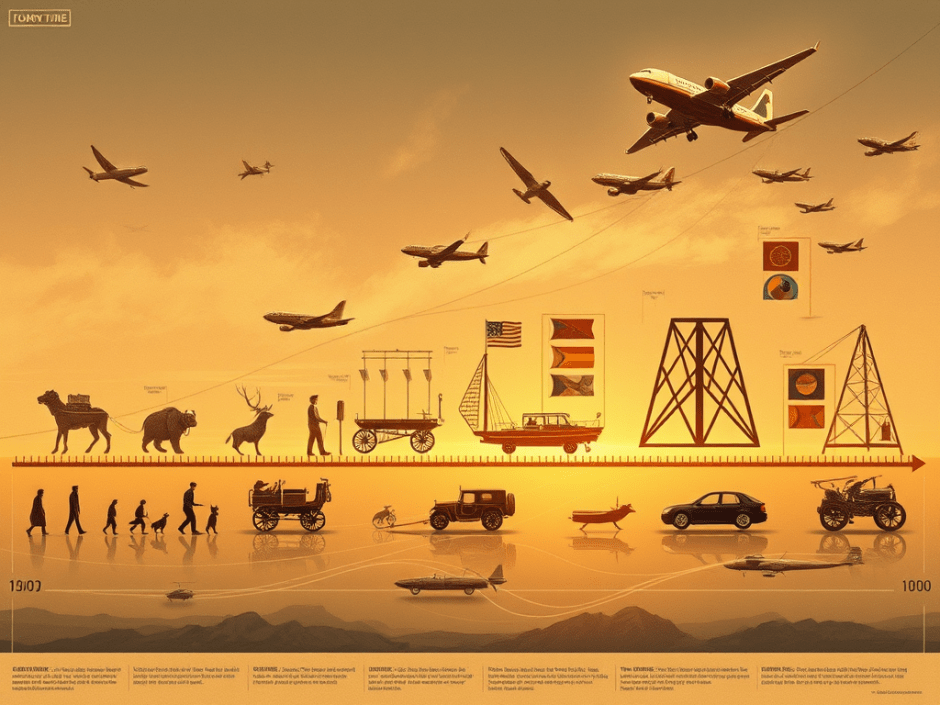
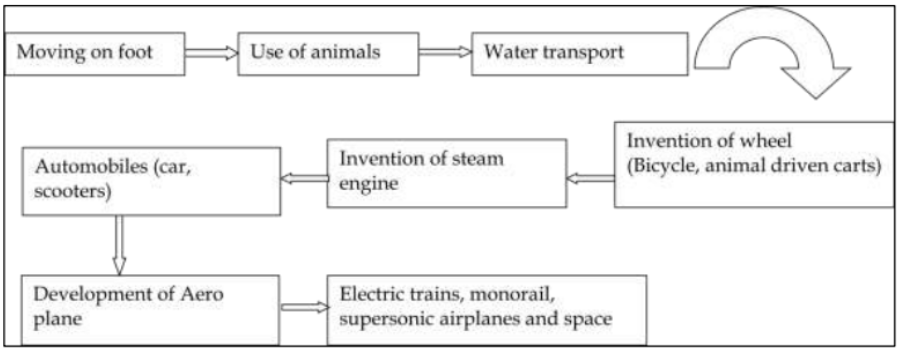
- Long ago people did not have any means of transport. They used to move only on foot and carry goods on their back.
- Later on they began to use animals for transportation.
Story of transport:
- Long ago people did not have any means of transport. They used to move only on foot and carry goods on their back.
- Later on they began to use animals for transportation.
- For transport through water routes, boats were used from ancient times. To begin with, boats were simple logs of wood in which a hollow cavity could be made. Later, people learnt to put together different pieces of wood and give shapes to the boats. These shapes imitated the shapes of the animals living in water. (e.g. streamlined shape of fish)
- Invention of the wheel made a great change in modes of transport. The design of the wheel was improved over thousands of years. Animals were used to pull carts that moved on wheels.
- Until the beginning of the 19th century, people still depended on animals, boats and ships to transport them from place to place.
- The invention of steam engine led to the development of new means of transport. Railroads were made for steam engine driven carriages and wagons.
- Later came automobiles such as motor cars, trucks and buses.
- Motorised boats and ships were used as means of transport on water.
- The early years of 1900 saw the development of aeroplanes. These were later improved to carry passengers and goods.
- Electric trains, monorail, supersonic aeroplanes and spacecraft are some of the contributions of the 20th century.

Different units of measurements in ancient times
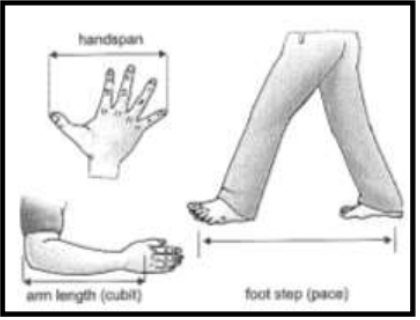
- In ancient times, the length of a foot, the width of a finger, and the distance of a step were commonly used as different units of measurements.
- Handspan: The size of the hand is used as one handspan
- Footspan: The size of one foot is one footspan
- A cubit as the length from the elbow to the finger tips was used in ancient Egypt and was also accepted as a unit of length in other parts of the world.
- People also used the “foot” as a unit of length in different parts of the world. The length of the foot used varied slightly from region to region.
- People measured a “yard” of cloth by the distance between the end of the outstretched arm and their chin.
- The Romans measured with their pace or steps.
- In ancient India, small length measurements used were an angul (finger) or a mutthi (fist). Even today, we can see flower sellers using their forearm as a unit of length for garlands in many towns of India. Many such body parts continue to be in use as unit of length, when convenient.
- Angul- Angul is finger width
- Muthi- Rice was measured using muthi.
- In 1790, the French created a standard unit of measurement called the metric system.
Standard unit of measurements
For the sake of uniformity, scientists all over the world have accepted a set of Standard units of measurement. The system of units now used is known as The International System of Units (SI units).

Definition: A standard unit is a unit used to measure any quantity completely and uniformly.
- The SI unit of length is a metre.
1 m = 100 cm
1 cm = 10 mm
1 km = 1000 m
- The SI unit of weight is a gram.
- The SI unit of capacity is a litre.
- The SI unit of time is a second.
- The SI unit of temperature is a kelvin.
NOTES
Measurement
Measurement/Unit (Defn): Measurement is the process of comparing the quantity of the object to be measured with a known fixed quantity of the same kind. This fixed quantity is called a unit.
Unit (Defn): A quantity adopted as a standard of measurement of a physical quantity is called unit.
Parts of measurement:
The result of a measurement is expressed in two parts.
- One part is a number.
- The other part is the unit of the measurement.
Example:
When you go to shop for your groceries, the weight of the vegetables is measured by comparing it against fixed weights. Suppose you buy tomatoes weighing 5 kg, then 5 is the number part and kg is the unit.
Some unit of measuring length in olden times:
- Handspan – The size of the hand was used as a unit of measurement.
- Footspan-The size of one foot was used as a unit of measurement.
- Cubit-The length from the elbow to the finger tips was used as a unit of measurement.
- Yard-The distance between the end of the outstretched arm and the chin was used as a unit of measurement to measure cloth.
- Footstep– Pace or steps were used as a unit of measurement by the Romans.
- Angul-A finger width was used as a unit of measurement.
- Muthi– The quantity of grains that could fit in a fist was used as a unit of measurement.
- Fathom-length of the outstretched arms was used as a unit of measurement.
Q) Why can’t we use handspan or length of foot as a unit of measurement?
Ans)
- In earlier times, people used different parts of their body to measure length such as hand span, cubit, footstep, foot and fathom.
- These units based on the length of the body parts are not accurate and reliable as the length of the body parts varies from person to person.
- Therefore, people realized the need for standard units of measurement.
SI Unit
Standard Unit (Defn): A standard unit is a unit used to measure any quantity completely and uniformly. This set of units is known as the International System of Units and the units of this system are called ‘SI Units’
- For the sake of uniformity, scientists all over the world agreed to use the same set of standard units for measurement which is known as SI unit.
- SI unit is the world’s most widely used system of units in both everyday commerce and science.
Used for three basic Quantities: The original SI units for used for three basic physical quantities are:
| Physical Quantity | SI Units | |
| 1 | Length | Meter |
| 2 | Mass | Kilogram |
| 3 | Time | Second |
The multiples and sub-multiples of measurements:
Q) Why do we need multiples and sub-multiples of measurements?
Ans)
- The unit of measurement of length is metre. But, when we want to measure the length of something small like pencil or eraser, metre becomes too large a unit and causes inconvenience. Or if we want to find the mass of something as small as a pebble, using kilogram as the unit of measurement is not suitable as it is too large compared to the object to be measured. In such cases, we can use sub-multiples of the unit to be measured.
- Similarly, in situations where the SI unit of measurement becomes too small like for measuring large distances between two cities, a metre scale will not be suitable. We would need a larger unit of measurement like a kilometre. In such cases, we use multiples of the unit of measurement.
- Depending on the magnitude of the object to be measured, the appropriate multiples or submultiples of the unit are selected.
Q ) What are the advantage of SI system?
Ans) SI system ensures that measurements are consistent and comparable across different countries and disciplines
Measuring the length of a curved line:
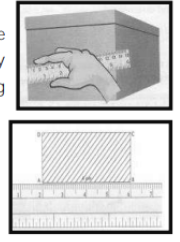
We cannot measure the length of a curved line directly by using a metre scale. The length of a curved line can be measured in two ways:
- By using thread.
- By Measuring tape
- By using a pair of dividers.
Motion
Key concepts of motion:
- Rest/stationary bodies (Defn): If a body does not change its position with time with respect to an observer, the body is said to be at rest with respect to that observer. These bodies are called stationary bodies.
- Motion (Defn): If a body changes its position with time with respect to an observer, the body is said to be in motion with respect to that observer.

Types of motion
1.Rectilinear/Linear motion:
Definition: The Motion which is in a straight line is called linear or rectilinear motion.
Examples:
- A car moving in a straight line
- A ball falling freely from the roof of a building or the falling of a stone
- The motion of a striker on the carom board
- Bow and arrow
- Dart
- Elevator
- Light and gravity
- A ball going upwards
- Pen moving with the help of a scale
- Rook in a chess game
- Motion of a vehicle on a straight road.
- March-past of soldiers in a parade
- Sprinters in a 100-metre race also move along a straight track
2.Circular motion
Definition: The motion in which the object moves along a circular path is called as circular motion. The distance of the object from the centre will remain constant.
Examples:
- Artificial satellites moving around the earth
- Moon around the earth
- An athlete running a race on a circular track,
- Carousels
- Going through a loop on a roller coaster
- Twirling a lasso
- Blades of a fan
- Hands of a clock
- Turning a car
3.Oscillatory motion:
Definition: The motion in which the object moves to and fro from an original position of rest (its mean position) is called as an Oscillatory motion
Examples:
- The pendulum of a clock
- A swing
- A merry- Columbus
- A yo-yo
4.Periodic Motion
Definition: The motion of an object that repeats itself at regular intervals of time is called Periodic motion.
Examples:
- Sewing machine needle that moves up and down continuously,
- Revolution of earth around the sun
- A branch of a tree moving to and fro
- Motion of a child on a swing
- Strings of a guitar
- The membrane of drums (tabla) being played
- Pendulum
5.Rotationary/Rotational motion
Definition: The circular movement of an object around a central line, or axis of rotation is called Rotational motion
Examples:
- Potter’s wheel
- Motion of a top
- Motion of a spinning ball
- Motion of a twirling ice skater
- Motion of a Ferris wheel
- The earth rotating on its axis
6.Curvilinear motion

Definition: The motion of an object that moves along a curved path is called curvilinear motion
Examples:
- People running on a track
- A car turning left or right
- Movement of a snake
- The curved route of a ball thrown at an angle above the ground
- Motion of an earthworm
7.Vibratory Motion
Definition: The motion in which the object moves to and fro but very fast is called as Vibratory motion. It is a type of Oscillatory Motion.
Examples:
- The strings of violin
- Phone put on vibratory mode
- Bobble head when touched
- Drum skin vibrating when hit
8.Uniform Motion:
Definition: The motion that has uniform speed is called uniform motion.
Example:
- An aeroplane travelling at a constant speed
- Motion of a fan’s blades
- The motion of the earth around the sun
- A car travelling at a constant speed
Combination of motions:
- Motion of a Ball on the ground: The ball rotates around the axis but the axis itself is moving along a straight line. Thus, the ball executes a linear motion as well as a rotational motion.
- Wheels of a car: The wheels of a car rotate (rotatory motion) and at the same time move forward in a straight or curved path.
- A screw driver: A screw turned by a screwdriver has linear as well as rotational motion.
- Earth’s rotation and revolutions: Earth rotates about its own axis and also revolves around the sun at the same time. It has rotatory as well as circular motion.
Question and answers:
Q.1) Why you think the people of Indus Valley Civilisation must have very good measurement?
Ans) The people of the Indus valley civilisation must have used very good measurements of length because we see evidence in excavations of perfectly geometrical constructions.
Q.2) Why is there a standard unit of measurement?
Ans)
- In earlier times, people used different parts of their body to measure length such as hand span, cubit, footstep, foot and fathom.
- These units based on the length of the body parts are not accurate and reliable as the length of the body parts varies from person to person.
- Hence In 1790, the French created a standard unit of measurement called the metric system.
Q.3). Differentiate between distance and displacement.
Ans)
- Distance: The total length travelled from one point to another.
- Displacement: It is the Change in position of an object or shortest distance travelled from one point to another.
Q.4) How did you decide whether an object is in motion or at rest?
Ans) The object when in motion is not at the same place after some time, while the object at rest is at the same place. On this basis, we may have decided whether an object is at rest or in motion.
Q.5) What is a unit? And it is expressed in how many parts?
Ans)
- Measurement means the comparison of an unknown quantity with some known quantity. This known fixed quantity is called a unit.
- The result of a measurement is expressed in two parts. One part is a number. The other part is the unit of the measurement.
Q.6) What are the things we need to keep in mind while taking measuring with a scale?
Ans)
- Proper position of the scale: Placing the scale in contact with the object to be measured and exactly along its length (parallel to the length) to be measured.
- Damaged Scale: In some scales, the ends may be broken and the zero mark is not seen clearly. Measurement should be taken by placing any prominent mark (1 cm or 2 cm) of the scale at the starting end of the object instead of the zero mark. By subtracting the initial (starting) reading from the final reading (at the other end), the required length can be obtained.
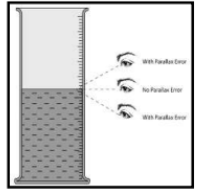
- Correct position of the eye: The eye must be exactly vertically above the point where the reading has to be taken.
Q.7) What are the possible errors that may occur while measuring length using a scale and how are they avoided?
Ans) There can be three possible errors that may occur while measuring length using a scale.
- Placement Error: An error may occur due to the wrong placement of the scale.
Corrected: This error can be avoided by placing the scale in contact with the object to be measured and exactly along its length (parallel to the length) to be measured.
- Initial Error: An error can be caused due to the worn-out edge of the scale.
Corrected: This error can be avoided by placing any prominent mark (1 cm or 2 cm) of the scale at the starting end of the object instead of the zero mark. By subtracting the initial (starting) reading from the final reading (at the other end), the required length can be obtained.
- Parallax Error: An error can occur due to the wrong position of the eye while taking the reading.
Corrected: It can be avoided by keeping the eye vertically above the point where the reading has to be taken.
Q.8) Difference between motion and rest
Ans)
| Motion | Rest | ||
| 1 | If a body changes its position with time with respect to an observer, the body is said to be in motion with respect to that observer. | 1 | If a body does not change its position with time with respect to an observer, the body is said to be at rest with respect to that observer. |
| 2 | A car movingA pencil moving while writingWaves in the ocean A giant wheelA merry-go-roundA merry Columbus | 2 | A parked carA student sitting at a deskWater in a lakeA tyre kept on the floorPencil in a case |
Q.9) Give two similarity and two differences between rectilinear and curvilinear motion.
Ans)
Similarities:
- Both are types of motion
- Motion Involves Displacement: Both rectilinear and curvilinear motions involve a change in the position of an object.
Differences
- Path of Motion:
- Rectilinear Motion: The path of the object is a straight line.
- Curvilinear Motion: The path of the object is a curved line.
- Direction of Motion:
- Rectilinear Motion: The direction of motion remains constant as the object moves along a straight line.
- Curvilinear Motion: The direction of motion continuously changes as the object moves along a curved path.
Thanks a lot for visiting my blog. Please do ‘★ LIKE’ the post if you found it to be useful. Your comments, suggestions, criticism and all opinions are very much appreciated. Please do write your queries in the Reply/comments section and I will try to get back to you asap.

All the content on this blog is copyrighted. It takes immense research, hard work, patience and time to come up with a comprehensive article/post. If you like and need to use any of my article(s) or any part of it, please do give the requisite reference, link or credit to my website/blog . DO NOT COPY WITHOUT PERMISSION.
 Raising Twins™